
VIU student talks about her time at COP 30 in Brazil

This year at COP 30, delegates focused on developing roadmaps to phase out fossil fuels and address deforestation worldwide. (Kiara Worth/UN Climate Change [CC BY-NC-SA 4.0])
Every year, world leaders, scientists and climate activists meet to make decisions around addressing the climate crisis, and this year, some students from Vancouver Island University were able to witness it.
The United Nations Climate Change Conference, also known as COP, recently wrapped up in Belém, Brazil, located in the Amazon Rainforest, for the 30th session.
This year at COP 30, delegates focused on developing roadmaps to phase out fossil fuels and address deforestation worldwide.
Jessica Lee was one of the Vancouver Island University students who attended COP 30.
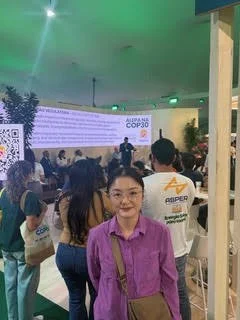
Jessica Lee (pictured) was one of the Vancouver Island University students who attended COP 30. Photo courtesy of Jessica Lee
“You see, people who are like the locals, they love their rainforest, and especially the Indigenous community, it's their way of connecting to the natural world. You can see people who are directly affected by deforestation and are concerned about climate change,” Lee said. “You can also see people from the delegations who are dealing with different environmental and climate challenges, and they all come together at the global conference to negotiate and make clauses under the same global climate framework. So seeing what I learned in class about climate change and seeing how we operationalize on the ground, was very exciting.”
Lee is currently finishing her final year studying political science at VIU and is now living in Thailand as she starts her PhD.
“My PhD thesis will focus on equitable extraction and utilization of natural resources in developing countries, [with a] focus on Southeast Asia,” she said. “Building on the insights I gained at the COP 30, my research will examine how environmental policies, community rights and resource governance intersect regions experiencing both ecological vulnerability and developmental challenges.”
With her interest in environmental and Indigenous governance, she was excited to attend COP 30 and meet people from around the world with the same interests.
She said attending the conference allowed for more practical experience in policy-making. One presentation that stood out for her was on Brazilian gold mining, which has been a factor in the rapid deforestation of the Amazon Rainforest.
“The presentation looked at how the extractive industry can be done in a fair and socially responsible way,” she said. “It's very important as the world demands for minerals and renewable technologies increase, and these are renewable energy, including wind, solar, to biomass.”
Lee was able to attend COP 30 after she won the Canadian Queen Elizabeth II Diamond Jubilee Scholarship through VIU. According to VIU, the scholarship is awarded to students based on academic achievement and community involvement.
The scholarship allows students to participate in a global exchange program between Canada and other Commonwealth countries with the goal of developing a new generation of global leaders to amplify community development.
Lee was able to attend a field study in Senegal, West Africa, before attending COP 30.
“I would definitely recommend anyone who has a chance to either attend VIU or take all the opportunities that VIU has to offer, such as the Queen Elizabeth Scholarship,” she said. “Take advantage of those opportunities and broaden your horizon, as well as your geography. Learning about things from a theoretical framework, but also in practice, is really helpful, either from your academic career or your career in general.”
The Queen Elizabeth Scholarship is still currently being offered through VIU’s Social Sciences Department.
Funding Note: This story was produced with funding support from the Local Journalism Initiative, administered by the Community Radio Fund of Canada.