
Looking out for the ‘little guys.’ A new eDNA collection method to research Salish Sea forage fish
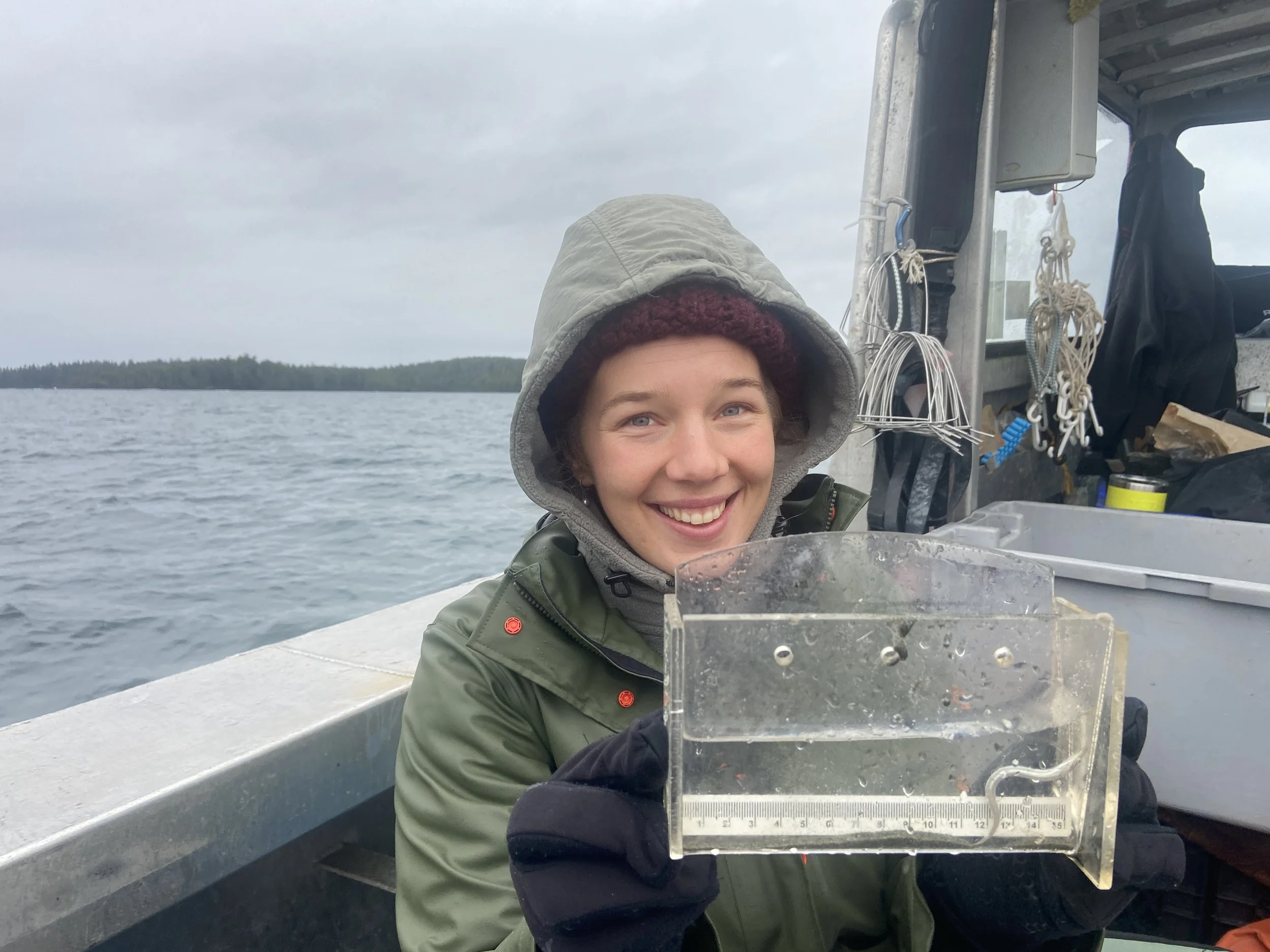
While these fish may be small and less desirable for humans to eat, these fish are a valuable part of the ocean ecosystem as they are food for some of the ocean’s top predators. Photo: Sophie Vanderbanck (Redd Fish Restoration Society)
In the face of a global biological crisis, a Vancouver Island research group is using new environmental DNA techniques to help better understand some of the coast's smallest fish.
Project Watershed, located out of the Comox Valley, has been monitoring Surf Smelt and Pacific Sand Lance, two different species of forage fish found around the coast of Vancouver Island.
While these fish may be small and less desirable for humans to eat, these fish are a valuable part of the ocean ecosystem as they are food for some of the ocean’s top predators.
In monitoring the population of forage fish along the Salish Sea, Project Watershed joined a team of researchers at the University of Victoria to find new methods for collecting environmental DNA.
Jacqueline Huard, forage fish project lead at Project Watershed, said environmental DNA, or eDNA, is DNA collected not directly from an animal, but from environmental samples such as soil, water, air, and snow.
“As any animal, but especially fish that we're focused on, as they move through their environment, they're constantly sloughing off and shedding bits of DNA. So it could be from hair, or, in the case of fish, would be like scales or slime,” Huard said. “Especially when they're spawning and they're dropping eggs or sperm into the environment, it's just full of DNA. So we can go around and pick up water or sand and then look for traces of DNA in that sample.”
For the last eight years, Project Watershed has been using eDNA to detect tiny traces of genetic material fish leave behind on the sand at beaches.
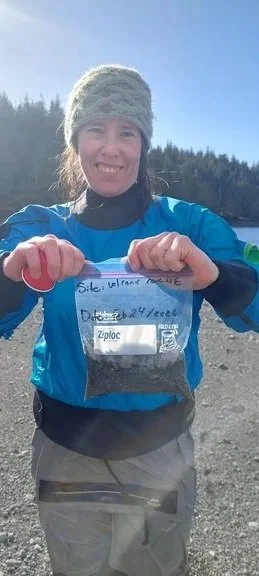
Jacqueline Huard holding up an environmental (eDNA) sample from a Vancouver Island beach on the west coast. Photo by Virginia East
“So right now, when we go to a beach, usually we collect about a cup of sand from each beach, which is made up of many tiny little scoops, like 30 to 100 little scoops across the beach of sand,” Huard said. “Then we take that sand, we put it in the freezer, and we get it down to [the university] lab, or right now we're using many, many samples, we send it to another lab,all the way in Guelph, and then they look in that sand, or DNA of Pacific Sand Lance and Surf Smelt.”
They have been sampling beaches around Vancouver Island to collect and monitor the eDNA left by the forage fish.
One small hurdle in research occurred, when some local First Nations did not want materials removed from their territories due to cultural significance, or a site being sacred. This included sand from beaches. Temporarily eDNA monitoring was halted until a culturally respectful solution could be found.
From this, Project Watershed worked with the forage fish researchers at the University of Victoria and developed a new collection method called the FloppE-Dip.
“We instead just use a special piece of paper. It's like the size of a toonie and it's charged so it can grab DNA. What we do is we go along the beach, we collect the sand as if we normally would, we put it in a Ziploc bag–very high tech tools–and then we add some regular drinking water that would have no chance of having come across their DNA before, we add that in, we add in that special piece of paper, and we shake it around for a minute. I like to think of it as our ‘shake and bake’ method,” Huard said. “Then we take that piece of paper out, and we add it to a little envelope with some silica packs, and we send that to the lab instead of the sand, and the sand can get put back on the beach immediately.”
Huard said while different species of forage fish can be found around the world with some countries heavily researching the fish or even commercial fishing them, there are still a lot of unknowns when it comes to local species.
“We're gaining more momentum for where these species are, and what predators eat them, and how important they are to the ecosystem, but it's still largely a mystery,” Huard said. “We don't know how well the populations are doing. We don't know if they're growing or collapsing.”
They said that monitoring and understanding these fish means supporting other species like salmon, whales and the endangered marbled murrelet that use the fish as food.
Huard said that with their eDNA data they have been able to create a habitat suitability model for forage fish on the Salish Sea.
“Built on citizen science data, it is now being used by [Fisheries and Oceans Canada] and other land managers like First Nations or regional areas, but especially by DFO in their essentially their permitting department,” Huard said. “When DFO is looking at whether or not a project should go forward, if someone says, ‘Hey, we want to build a dock here,’ or ‘hey, we want to build this big terminal like RBT2 (Roberts Bank Terminal 2), DFO now has a tool to look at and say, ‘Hey, is there habitat for Pacific Sand Lance here?’ When previously, Sand Lance habitats were not considered to be used by a lot of fish, and so it wasn't really that highly valued by managers.”
With this model, Huard said it helps mitigate the impacts to the local forage fish habitats.
Now Project Watershed is working to create a habitat suitability model for the west coast of Vancouver Island after collecting data for the last three years. They hope in future years they will be able to conduct further research and build suitability models for the Queen Charlotte Strait, Queen Charlotte Sound, and the Central Coast and Haida Gwaii area.
“As you might imagine there's First Nations everywhere, but they dominate in the north and central coasts in terms of land managers,” Huard said. “So I think that there will be more places where we will need to use this new technique so that we're not taking sand away from the beaches.”
Huard said that not monitoring forage fish populations creates an unknown. Lack of monitoring these key species could lead to devastating, but preventable, effects on ocean ecosystems if they were to collapse before action could be taken.
Funding Note: This story was produced with funding support from the Local Journalism Initiative, administered by the Community Radio Fund of Canada.