
Climate scientist warns warmer and drier conditions on Vancouver Island could lead to more severe wildfires this season
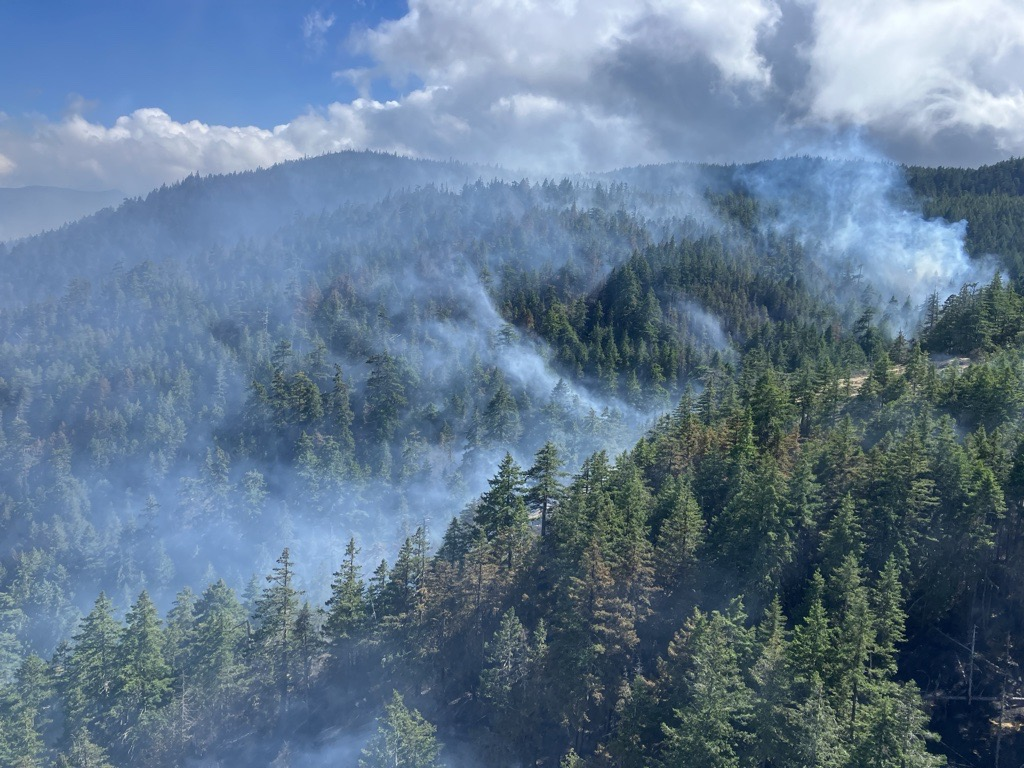
Photo from the Wesley Ridge wildfire taken in Aug. 2025. (B.C. Wildfire Service)
Fire season is underway in B.C. This year it could be more severe than usual. According to the B.C. Wildfire Service, 214 wildfires have been extinguished throughout the province since April 1. The season typically lasts from April to October, per Canada Wildfire. This year, climate scientists are seeing higher temperatures and drier conditions.
”Our forecasts are indicating that the summer temperatures will almost certainly be warmer than the sort of recent historical average. We use 1991 to 2020 as a sort of baseline period. Chances are greater than 90 per cent according to the forecast that it will be warmer than that historical norm. It’s much more difficult to predict precipitation, but the forecasts are tilting towards a drier than normal few months particularly in May as we've been seeing,” said Bill Merryfield, Environment and Climate Change Canada research scientist based in Victoria.
Merryfield specializes in predicting seasonal to decadal climate conditions. He talked about the impact the drier season would have on wildfires in Vancouver Island.
”For Vancouver Island the tendency towards a possibly drier but especially warmer summer is indicating a higher severity than usual for a particular time of year. So that doesn't necessarily mean in May, for example, that wildfire activity will be especially severe, but it does indicate there'll be a higher tendency for it to be severe than you would normally have at this time of year,” said Merryfield.
“ But as we get into July particularly, those forecasts are indicating that yeah, there's a chance that wildfire activity on the southern half of Vancouver Island will be more severe than usual.”
In February, the Ministry of Water, Land and Resource Stewardship, found that Vancouver Island saw lower than normal snowpack in 2026, at just 39 per cent of normal. Merryfield explained the impacts this will have in the summer.
”Of course we've had increasing drought conditions in recent weeks. So those things, having a dry start going into summer will definitely tend to worsen the wildfire danger. A few good rainfalls could change that. But as of now the dryness on Vancouver Island certainly will be contributing to the severity of wildfire season,” said Merryfield.
Merryfield said that conditions have been trending warmer and drier for decades.
“Summers in Nanaimo, since the late 1940s, have been getting warmer and drier. And so the average summer in the present day is tending to be somewhere between a degree to two degrees warmer than it was in the late 1940s. And the summer rainfall during that time has gone down by somewhere around 10 to 20 per cent. The climate simulations predict that these trends will continue in the future due to the overall warming of the Earth's climate and primarily caused by the increase of greenhouse gases in the atmosphere,” said Merryfield.
Merryfield said that the unusually dry recent climate could be due to a variety of factors.
“Rainfall does vary naturally in a fairly random manner. And in some parts of the world, in some seasons, you can make a direct connection to other things that are going on with the climate, such as El Niño and La Niña. But in Canada, it's largely a matter of random variability. There may be other factors involved but at the moment, those aren't very well understood,” said Merryfield.
Fire updates and warnings are available through the Coastal Fire Centre.
Funding Note: This story was produced with funding support from the Local Journalism Initiative, administered by the Community Radio Fund of Canada.