
Presenting a New Forest Act in Courtenay
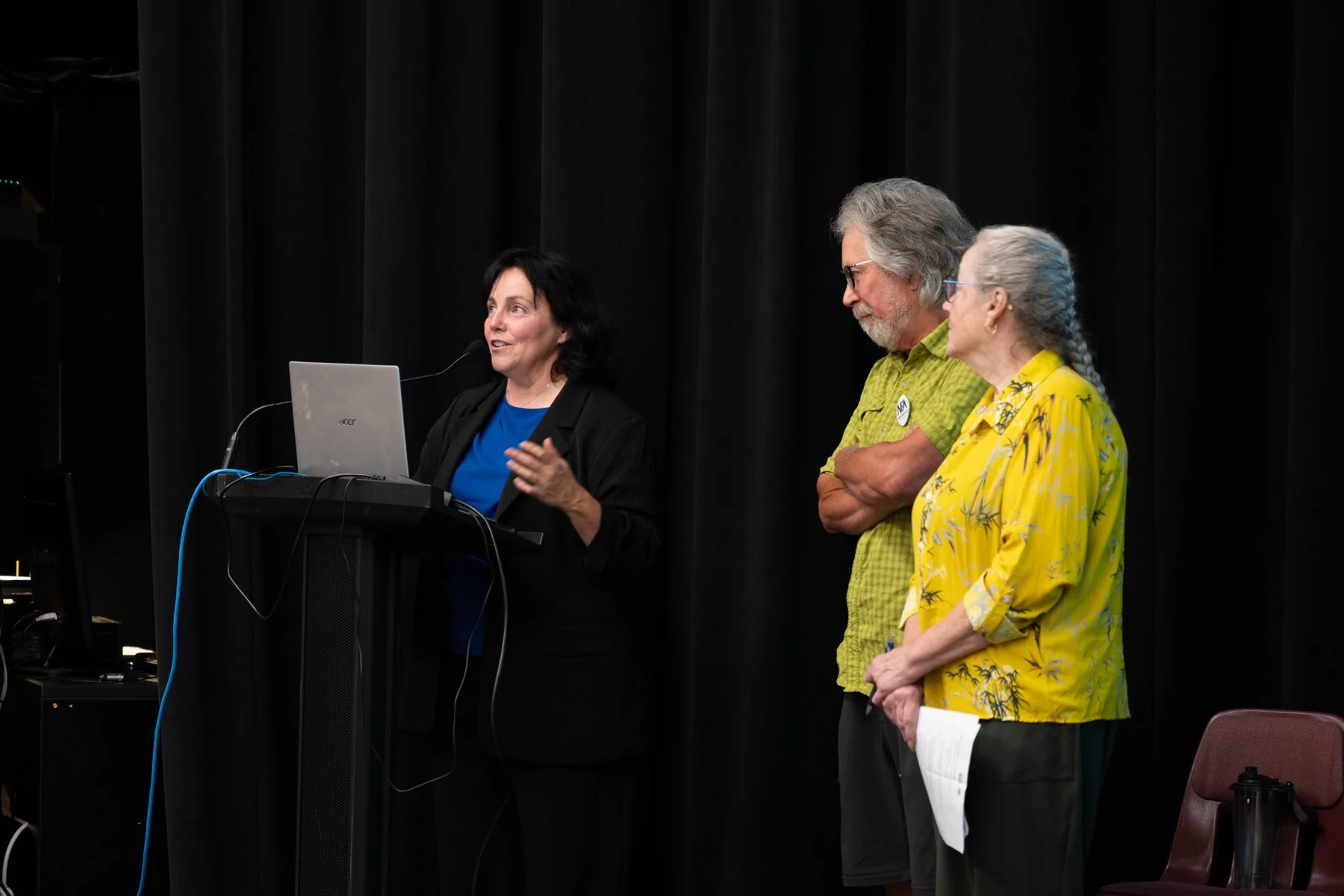
Presenter Jennifer Houghton is the campaign director for the proposed New Forest Act. (Jeannie Lin / CHLY 101.7FM)
On Monday night, the New Forest Act Roadshow, a campaign to reform provincial forestry legislation, stopped in Courtenay. The event was hosted by local organization Save Our Forests Comox Valley, as part of a series of presentations throughout B.C.
“The new Forest Act is a citizen-developed legislative proposal, and it's meant to replace the current forestry legislation in B.C. It has three key priorities. The first one is ecological integrity. The second one is community-based decision-making, and the other is community economies,” said Jennifer Houghton, campaign director for the proposed New Forest Act.
The New Forest Act is a campaign of the Boundary Forest Watershed Stewardship Society (BFWSS), an organization based in Grand Forks that advocates for forestry protection. According to the organization, the New Forest Act is a fully developed legislative framework that prioritizes community input and shifts control to public-interest stewardship. Throughout the month of June, Houghton is touring 12 communities throughout B.C. to advocate for the proposed framework.
The stewardship society is no stranger to giving the province feedback in the area of forestry or watersheds, making submissions to the Forest and Range Practices Act Improvement Initiative, a three-phase effort of the province to address climate change and strengthen forest resilience. Houghton, through the stewardship society, developed the New Forest Act framework in 2024, along with project advisor and Vancouver Island-based forestry professional Dave Weaver. Weaver said that the current forestry legislation is in need of reform.
“It's a timber-driven legislation where the priority is to produce, manufacture logs out of forests for timber production, and the sale of that wood. And the issue has been that, that has been the priority, and other values have been compromised. Wildlife, biological biodiversity, habitat. Rates of harvest are controlled in the province on the public land, but here on Vancouver Island, we have a large area of private forest land, and the rates of harvest are not controlled. So the rate of harvest is the real concern,” he said.
Weaver said one of the goals of the proposal is watershed protection. He explained the role forestry plays in the water supply.
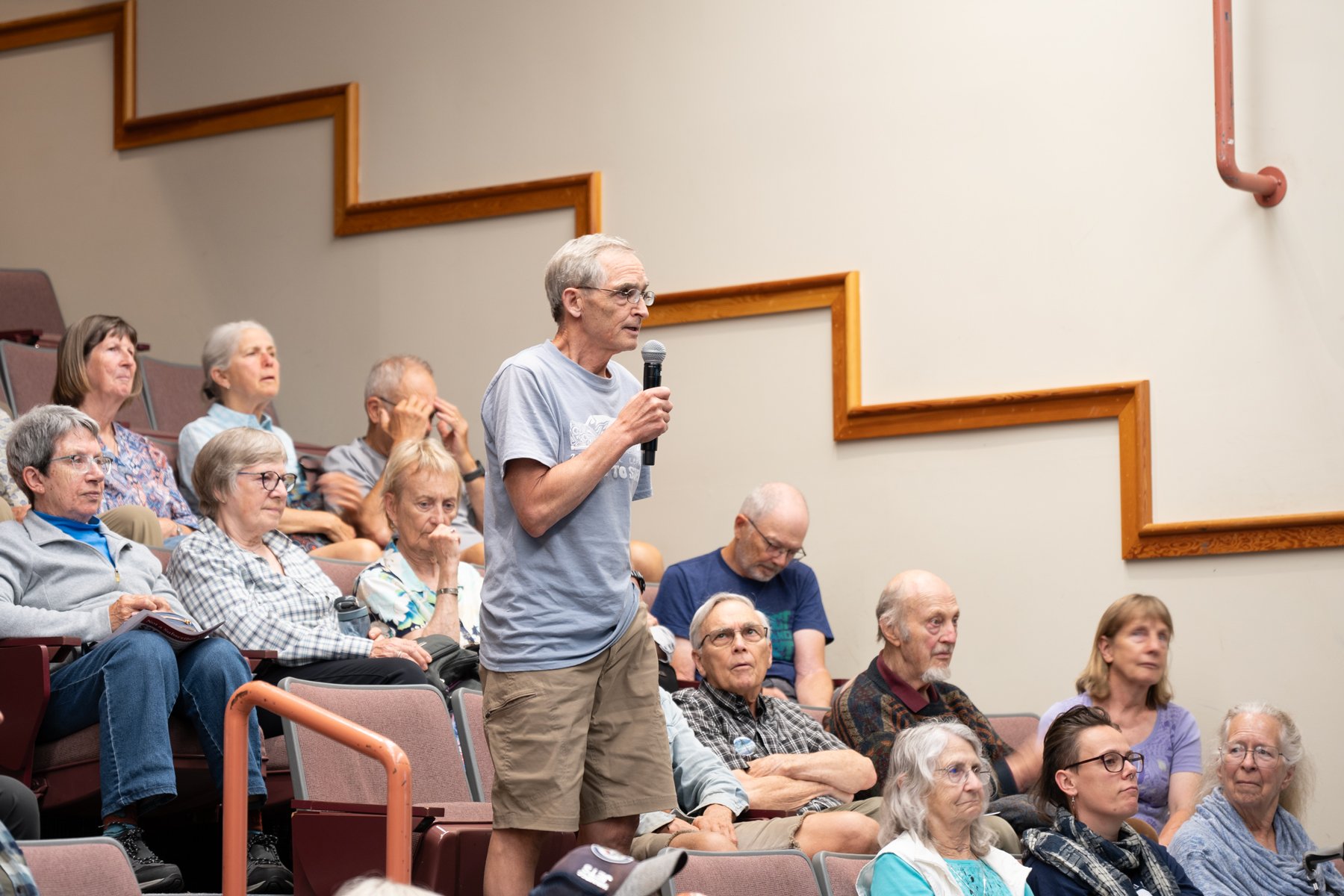
The audience asks questions at the event. (Jeannie Lin / CHLY 101.7FM)
“The amount of water that makes it into the watershed or doesn't make it into the watershed is a function of how much forest is there. The aquifers that charge wells or charge our water supply is a function of the trees intercepting that rain or slowing it down and letting it drip into the soil rather than letting it run right off. If there's no trees there, if they're recently logged, and the snow is on the ground, and when it comes to thaw, there's no protection of that snow at all, and it just melts immediately,” he said.
According to Natural Resources Canada, forests can help mitigate climate emergencies by balancing carbon, regulating water cycles and maintaining soil moisture. Weaver explained how forest loss could worsen climate disasters.
“ Nowadays with ecosystems stretching and stretching more because of climate change. Forests play, intact forests play a huge role in mitigating, if anything, droughts and fire risk and all of these things. If we lose all our forests continually at the rate that we have now, and some watersheds are at that point, droughts, wildfires, floods, these are events that are going to happen more with climate change, and they will be exacerbated if we don't have forest cover,” he said.
The proposal divides the province’s forests into three categories: those needing protection for ecological integrity, those with damaged ecosystems needing restoration, and those for harvest where ecosystems can be sustained.
“ We talk about a zone, breaking the province into three zones, areas that should be protected, which would be all primary and old-growth forests. The second one would be areas that need restoration, and that would include fireproofing and identifying that at a large scale,” said Weaver.
In B.C., there is no law establishing the minimum age of forest stand for harvesting. According to the Forest Practices Board, each Timber Supply Area (TSA) establishes their own minimum harvest criteria for age and or volume. Weaver said that the New Forest Act is proposing harvest levels shift to small patches rather than large clear-cutting.
“The framework within the New Forest Act is to use nature-directed stewardship, which is an approach that is quite Indigenous and it is an ecologically sound approach. That means that you should, whenever any harvesting goes on, that the forest should be left in a functional forest state, ecologically functional state, so it's not in a recovery state. In other words, not huge clear cuts,” he said.
Houghton said that if reform isn’t implemented, jobs within the forestry sector may face an unstable future.
“We're already at the point where timber harvest is getting depleted. And so we're already at the point where forestry is having trouble accessing good quality timber. And so what's happening is there's lower quality timber, there's less of it available, it's harder to access, it's more expensive to haul, and because of that, mills are closing down, and hundreds of jobs are being lost in B.C. every year,” she said.
According to B.C. Forestry Workers, the industry has faced a 45 per cent drop in employment since 2001. In December 2025, North American forestry company Domtar announced the closure of the Crofton Pulp Mill on Vancouver Island, leading to job losses for 350 employees.
“Communities are suffering, and the timber just isn't there anymore, to sustain the industry. The industrial extraction style of forestry that used to sustain B.C. is just not possible anymore,” said Houghton.
Houghton said one of the goals of the proposal is to eliminate industrial extraction and for ecological limits to be built into law. New Forest Act campaigners are asking communities to call on the provincial government for reforms. Houghton and her team are continuing the provincial tour on Vancouver Island for the rest of the month with the finale in Victoria on June 22.
Funding Note: This story was produced with funding support from the Local Journalism Initiative, administered by the Community Radio Fund of Canada.