
Ribit, working to eliminate invasive bullfrogs in Comox Valley
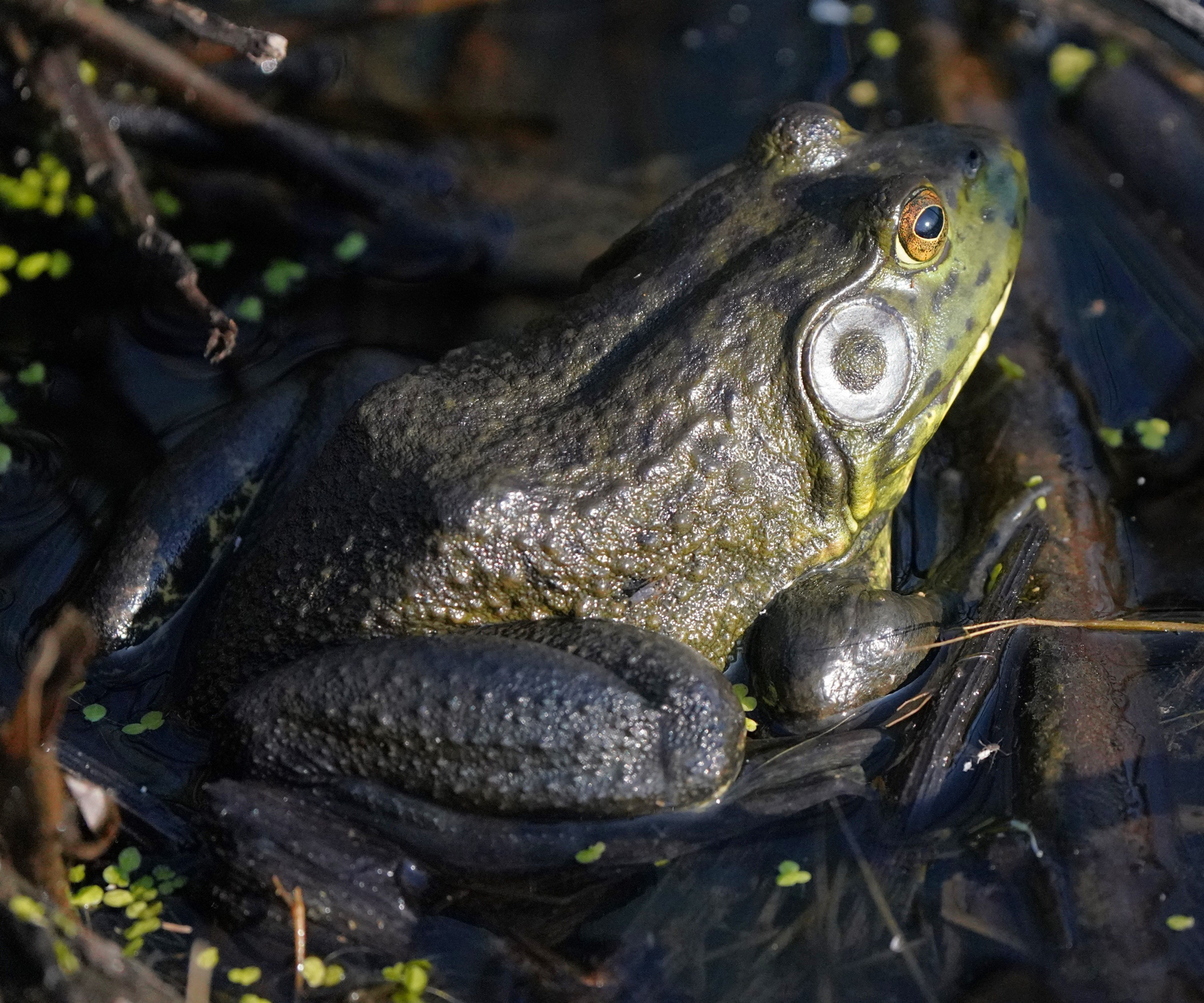
The American Bullfrog is considered an invasive species on Vancouver Island, damaging local ecosystems. It’s native range is eastern North America. (Richard Bloc / Pexels)

Katie Gair is teaching bullfrog trapping workshops this summer. (Jeannie Lin / CHLY 101.7FM)
A local organization is working to clear out invasive American bullfrogs in the Comox Valley, due to their ability to choke out native species.
“This is a problem that is throughout the Comox Valley. Lots of other watersheds, lots of other organizations have issues with bullfrogs,” said Katie Gair, the project coordinator of the Tsolum River Restoration Society, a volunteer-based organization that is working to restore the Tsolum River Watershed.
Throughout the summer, Gair will be holding free workshops at Lewis Park for participants to build their own traps for clearing out bullfrog tadpoles from their own ponds.
“So if you have a private pond, it's a really common issue that bullfrogs are keeping people up at night. They have this really guttural, deep, breeding call that the males make. And it keeps people awake at night. And it's just a concern, people knowing that this is a highly invasive species that is highly impactful on native amphibians. They just don't wanna see that within their property,” said Gair.
The traps are built by cutting holes in laundry hampers, which are then secured with zipties. A pool noodle is fastened on top of the trap to float in the water. Gair talked about the origin of the design.
“So we have a longtime member named Stuart McIntosh who has been doing tons of work with bullfrog control. He has created this trap out of common household items that we have been using for years now. We've found it to be very effective,” said Gair.
The workshop also teaches participants how to euthanize the tadpoles ethically once they are captured in the trap.
“It's important that even if they are invasive and problematic, that we treat them with respect, So the provincially recommended euthanasia protocol is using benzocaine gel, commonly known, the brand name is Orajel. It's a topical anesthetic gel that people commonly use for toothaches. You dissolve a measured amount into water and put the bullfrog adults or tadpoles into that water, and it anesthetizes them, which means it knocks them out, and then eventually, it euthanizes them by reducing their respiration, their heart rate, things like that, until they die functionally,” said Gair.
The invasive species isn’t just an issue in people’s ponds. Bruce Moffat is a volunteer at the Tsolum River Restoration Society. For a decade, he has been visiting Maple Lake, a fishing lake five km south of Courtenay, off the Inland Island Highway. He said he noticed the increase of bullfrog tadpoles in the past few years.
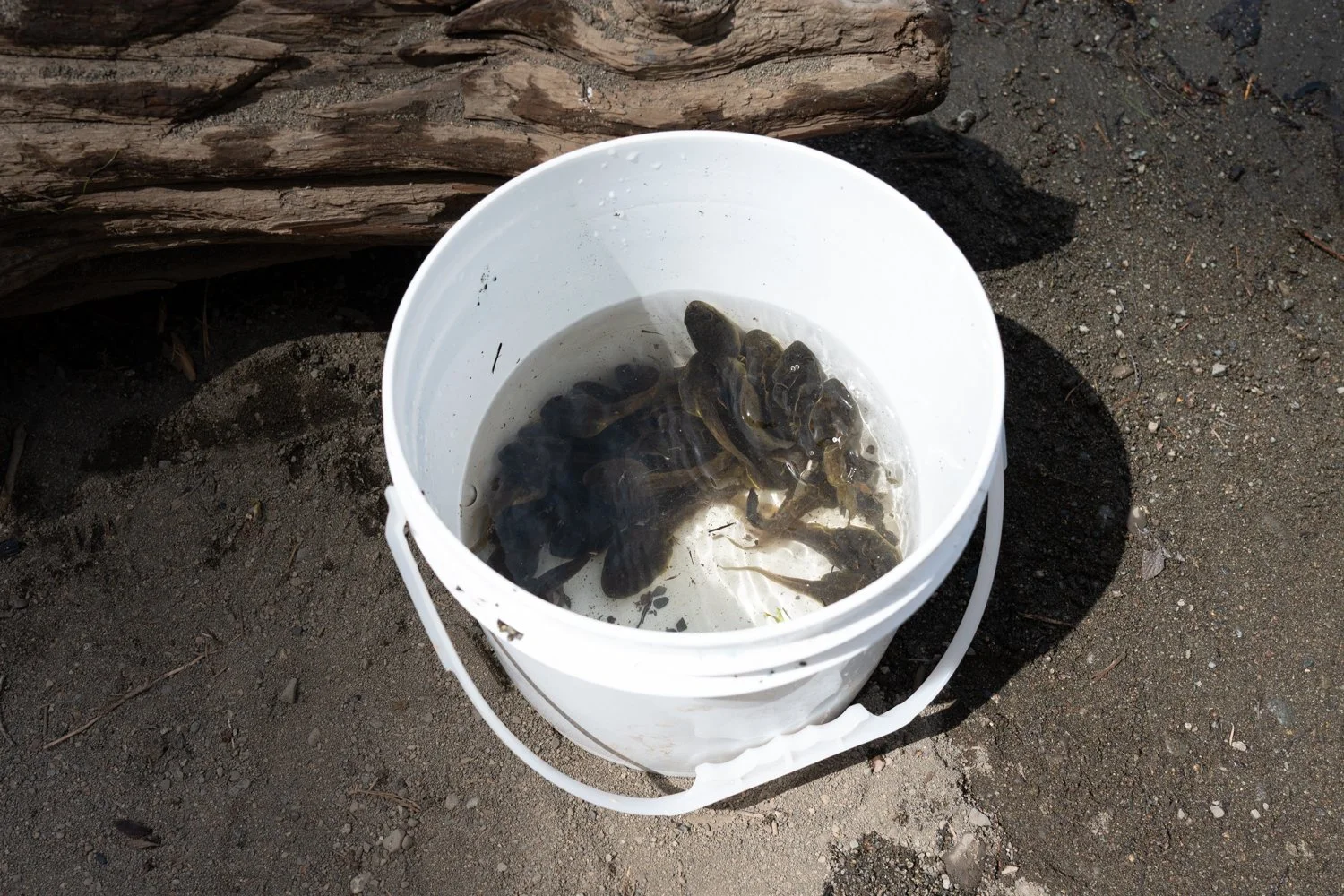
Bullfrog tadpoles are put into a bucket by hand after being caught in the net. (Jeannie Lin / CHLY 101.7FM)
“I noticed them here about three or four years ago. I just heard in the very backside of the lake the particular sound of their call, and it was like, ‘Uh-oh, we got some bullfrogs on Maple Lake.’ And I was like, ‘Okay, well live and let live.’ There's not, doesn't sound like there's very many. And then the following year I saw there was quite a few tadpoles, but it seemed to me maybe two or 300 tadpoles that were around. And I was like, ‘Oh, yeah, okay. They're tadpoles. Live and let live.’ And then it was just last fall when I was paddling around the lake, when I went through a patch of grass that was every centimeter was bubbling with tadpoles. I would've estimated there were thousands of tadpoles, and it was like, ‘Uh-oh,” said Moffat.
Although the laundry hamper method is effective for ponds and creeks, in larger bodies of water such as Maple Lake, the tadpole population is too great for laundry hampers to handle.
“The hamper traps just haven't had the trap efficiency that we'd like to see for the amount of tadpoles we're seeing in Maple Lake right now, so we thought we'd try some different strategies. We're very much in a phase where we're seeing what methods are most appropriate for this amount of bullfrogs, and for this size of a lake. We've mostly worked in small private ponds previously, so we're in a bit of an experimental phase right now with Maple Lake,” said Gair.
The volunteers of the Tsolum River Restoration Society visit Maple Lake periodically to remove these bullfrogs themselves, using large seine nets, which are typically designed to trap schools of fish. They throw the trap into the water and pull it back to shore once the tadpoles are inside the net.
Dr. Nicholas Wong is the Operator and Science Manager with the Invasive Species Council of BC. He explained the origins of this invasive species.
“American bullfrog is native to Eastern North America, and they were originally brought to B.C. back in the 30s and 40s for food production. That sort of never really took off, and they sort of escaped into the environment. Over time, historically, they were also sold in pet stores and markets and people kind of released them when they were no longer wanted. And people also tend to use them as fishing bait. So those are some of the ways they've been sort of introduced into the environment,” said Wong.
He said that throughout B.C., invasive American bullfrogs are most active around the Lower Mainland and southern Vancouver Island.
“They've been around and sort of an issue particularly in the lower mainland, in Vancouver Island, basically from Victoria to Campbell River and west of Port Alberni, and they've also been found on several Gulf Islands and in the Kootenays,” said Wong.
Wong talked about the amount of native species at risk because of these bullfrogs.
“These frogs are generalist predators, so they'll eat just about anything they can fit into their mouths. They'll prey on all the different life stages of our native frog species, so they'll eat the eggs, they'll eat the tadpoles and the frogs themselves, and some of which are species at risk, like the red legged frog, the northern leopard frog, and pacific chorus frogs. They'll also eat salamanders and fish, crustaceans. They've even found bats and rodents in the stomachs of bullfrogs. They'll also eat snakes,” said Wong.
Wong explained why their feeding habits are harming local ecosystems.
“They'll also compete with these other frogs and species for food and habitat. When they get large, they can have quite an impact on the local food webs so they can cause sort of ecosystem level issues. And they can also carry some pretty infectious diseases like chytrid fungus and random viruses and these could be introduced to native amphibians too,” said Wong.
Wong said climate change affects the ability for invasive species to thrive.
“Climate change is definitely impacting the distributions of native and invasive species. Often the thing with invasive species is they're just, they're much more physiologically tolerant. They can handle wider ranges and temperatures, and other environmental factors. So with changing climates, it's going to expand the distributions of these invasives, but then also push out some of the native ones into different locations because the climates are no longer conducive to where they are,” said Wong.
Wong said that bullfrogs are most active during the warmer summer months. Currently, the Tsolum River Restoration Society is running the Ribit program, also known as the Regional Invasive Bullfrog Initiative. Gair talked about the goal this summer.
“So our target eventually through the Ribit program is to identify areas where bullfrogs are encroaching on native amphibian habitat, which we believe Maple Lake would be one of those sites. And we can focus our efforts and energy in those areas to better conserve native amphibians, because it is a continuous effort. You can't just, you know, get rid of the bullfrog tadpoles once and expect that they'll stay away. Once you get rid of them, more bullfrogs will just move in, lay their eggs. So it is a continuous effort,” said Gair.
Gair is encouraging Comox Valley residents, especially those with ponds in their backyards, to learn more about the removal of these invasive bullfrogs, by attending workshops this summer. More information can be found at tsolumriver.org.
Funding Note: This story was produced with funding support from the Local Journalism Initiative, administered by the Community Radio Fund of Canada.