
Come on in the water’s fine! Testing water at beaches resumes for summer

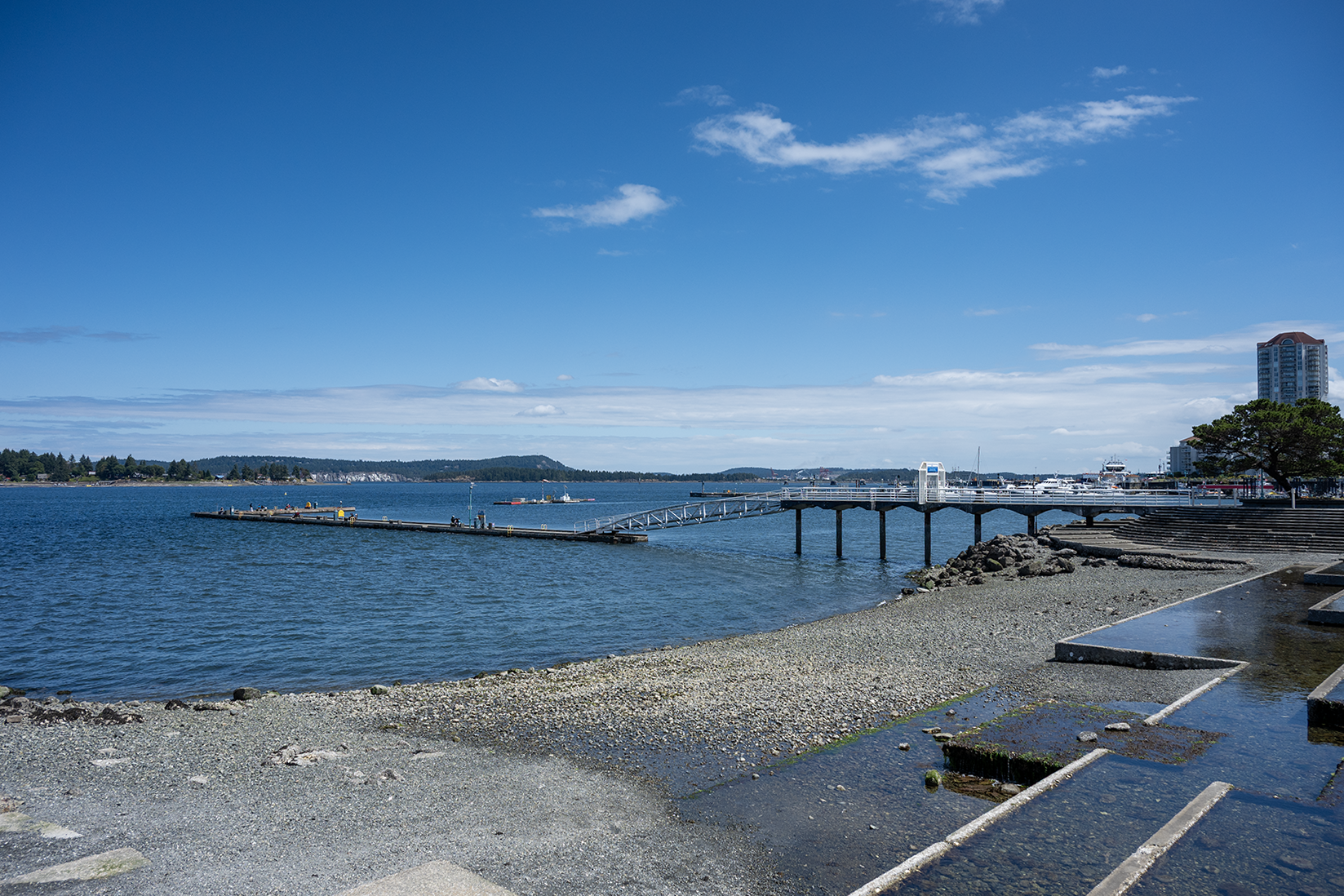
The City will test the water quality for Brannen Lake, Colliery Dam Park, Departure Bay, Long Lake, Sway-a-Lana at Maffeo Sutton Park (pictured) and Westwood Lake. (Luis Zablah / CHLY 101.7FM)
Nanaimo began its yearly summer water quality monitoring program on June 16, informing citizens that regular testing will continue throughout the season.
Every year, the City of Nanaimo performs routine water testing of the area’s bodies of water and beaches, checking for bacteria to ensure they are safe for the public. With help from the Nanaimo Port Authority, the city takes water samples from different fresh and salt water locations.
According to the official June 16 press release, the City will test the water quality for Brannen Lake, Colliery Dam Park, Departure Bay, Long Lake, Swy A Lana Lagoon in Maffeo Sutton Park and Westwood Lake. For the next few months, the City of Nanaimo will conduct tests each Tuesday and release the results the same Friday on their website as Beach Reports.
CHLY spoke with the City’s Assistant Supervisor in Drainage, Michael Olson, on how the annual water testing program works.
“We test for E. coli, and we take coliform counts, and I guess we take the samples, and then we send them off to a lab for them to be monitored and looked at, and then we get the results back from our lab, and and we post our results on the City of Nanaimo website every Friday.”
The main bacteria the test is looking for is E. Coli, a common fecal coliform found in animal feces. (Luis Zablah / CHLY 101.7FM)
The main bacteria the test is looking for is E. Coli, a common fecal coliform found in animal feces. If the coliforms are above Provincial health guidelines, it would lead to a beach closure by the City.
The City of Nanaimo also has bylaws requiring dog owners to stay away from beaches from May 1st to September 30th. To help keep the water clean and beaches open, owners are asked to take their dogs to designated dog parks and off leash areas.
Olson explains why the city is asking for people to follow the rules these coming months.
“We can't control the heat, we can't control, natural wildlife, but what we can control is essentially is how we're using the water, and how we're using the swim beaches by cleaning up after ourselves, making sure that if you need to go to the washroom, use the appropriate facilities, and ensuring that your pets are not, on the beaches where there was the designated swimming areas and attend the appropriate dog parks,” said Olson.
Nanaimo’s wildlife, such as shore birds are already a key factor with the water quality, the addition of pets could elevate the levels of fecal coliforms. The City of Nanaimo bylaw covers all of Nanaimo’s lakes, streams and waterfront swimming spots with the exception of the aforementioned off leash areas.
Staff has an organized report system with different categories, Olson goes in detail in how that system works.
“Everything is in our blue category. So we have a blue category, which is safe to swim, a yellow is moderate to issues, and then red, obviously, is, you know, no swimming, and so we kind of treat it like a traffic light, whereas instead of a green, we use a blue.”
Mercedes Hernandez, a Microbiology professor at Vancouver Island University (VIU), explains E. Coli further.
“Well E. coli is a bacteria, the full official name is Escherichia coli,” she said. “It's a bacteria, common found in the intestine on humans and many animals, is part of what they call our microbiome.”
She explains the process of water testing and how it is considered safe for swimming or not.
“E. coli is an indication of water contamination with fecal matter, and the more of the levels of E. coli you find in the water, then you know the more fecal contamination is there, and that means the more the risk that some bad bacteria, like some salmonella or the norovirus, which is the stomach flu or stuff like that, might be also in the water.”
She further explains that water testing follows standard procedures, where samples are collected and analyzed using consistent methods so results can be compared against pre established safety standards. If levels of E. Coli approach or pass those limits, monitoring would be increased, or even see swimming restricted.
Hernandez goes into detail about the effects E. coli might have on the public if the levels are left unchecked.

If levels of E. Coli approach or pass those limits, monitoring would be increased, or even see swimming restricted. (Luis Zablah /CHLY 101.7FM)
“Having fecal matter contaminating the water is a problem, because there are other bacteria that can be in the intestines of humans and animals, like Salmonella, Listeria, some viruses, like norovirus, you know, the stomach flu and parasites that can be transmitted between humans.”
Hernandez explains that the effects depend on the type of bacteria that's present, but illnesses connected to contaminated water can be gastrointestinal symptoms like diarrhea, stomach cramps, nausea and vomiting.
Additionally, CHLY spoke with Chris Gill, a Chemistry professor at VIU and Co-Director of the Centre for Health and Environmental Mass Spectrometry. He says there is a public health consideration.
“Well, I think, in terms of E. Coli, so this would be monitoring for disease vectors. Monitoring for this sort of thing, is to protect people from being exposed to these things, and either getting infections or worse, so that's an important step in protecting public health.”
Gill also explains the environmental conditions, such as warmer temperatures and how they can influence bacteria growth in waterways.
“The warmer the water is, the more easy it is for bacterial cultures to grow, and so that's part of the problem. I think human activity, you know, again, it's going to introduce more materials into the water system.”
As of now, two results have been officially released on the city of Nanaimo's website. For the last two weeks of June 16 and 26 no beaches have been closed as no water issues have been discovered. The next report will be published July 3rd.
Further information on the water testing and results is available on the City of Nanaimo’s website, as well as information on off-leash dog parks.
Funding Note: This story was produced with funding support from the Local Journalism Initiative, administered by the Community Radio Fund of Canada.