
New bridge improves safety, linking west and east Courtenay for cyclists and pedestrians
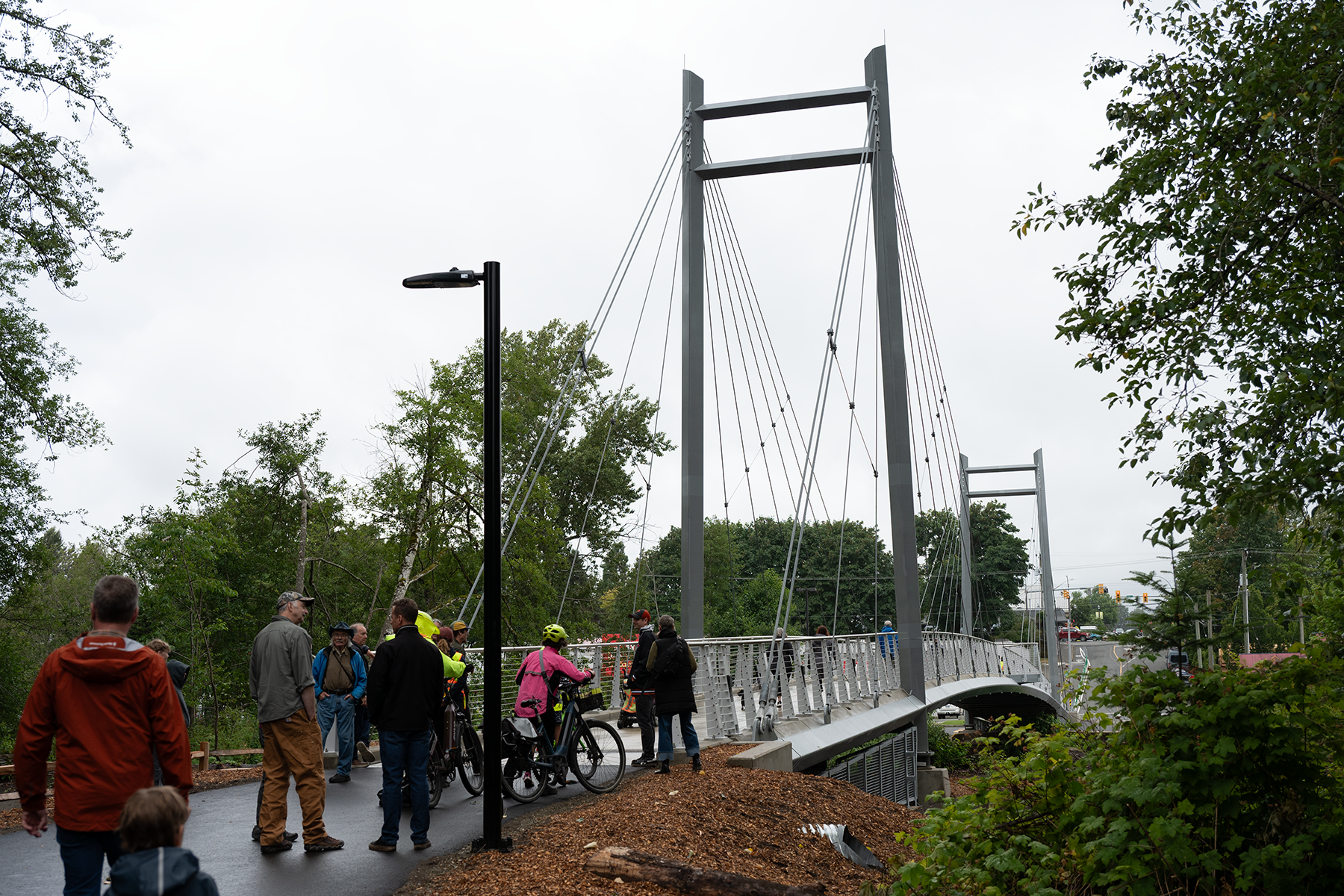
The 6th Street Active Transportation Bridge opened on June 24, and a ribbon-cutting ceremony marked the official opening on June 26. (Jeannie Lin / CHLY 101.7FM)
Pedestrians, cyclists and those in mobility devices are now able to travel between east and west Courtenay, away from vehicle traffic. The 6th Street Active Transportation Bridge opened on June 24, and a ribbon-cutting ceremony marked the official opening on June 26. Mayor of Courtenay Bob Wells said the bridge provides safer access for those not travelling by motor vehicle.
“For those that might be cycling or walking, or if they have another type of accessible mobility, they're able to get from one side to the other so much more safe. If we're able to get people around our community in a faster, more efficient way, that's better for work. It's better for people who are trying to get to appointments and stuff like that,” he said.
Wells said that this project will also support many community events in the area.
“This is a project that's been more than 20 years in the making. A grassroots community-driven idea that has culminated into what I think is gonna be, and I think as of today, the most iconic structure in the Comox Valley. And it's definitely gonna be a draw for people to come here, an economic driver for our downtown. It's gonna support the Simms Concert Series, as well as Canada Day and many other cultural events,” said Wells.
According to the City of Courtenay, the 6th Street Active Transportation Bridge is a four-metre-wide, cable-stayed bridge that connects pathways on both sides of the Courtenay River from downtown Courtenay to trails through Simms Park. Construction of the bridge began in September 2025, and was completed four months ahead of schedule and under budget.
Lawrence Vea is a former president of the Comox Valley Cycling Coalition, a member-run volunteer organization that promotes safe infrastructure for cycling. He said that connection is important for the community.
“The word connectivity, which is big in the cycling community. You know, you have a little piece of infrastructure that doesn't connect with another piece or at the other end doesn't, that's just no good, doesn't work. So we need connectivity. So this is great. Do we have connectivity to the other cycling lanes? Well, we need a little bit of improvement there. Now, the biggest problem with connectivity in the valley, in our minds right now, is connecting West Courtenay to East Courtenay,” said Vea.
In 2019, the City of Courtenay adopted its first Cycling Network Plan, which aims to establish infrastructure improvements over the next 20 years, including protected bike lanes, painted bike lanes, neighbourhood bikeways and multi-use pathways. According to the report, the goal is for 30 per cent of all trips in Courtenay to be made by walking, cycling or transit by 2030. Vea said that the cycling community is growing in the Comox Valley due to the increasing popularity of e-bikes.
“There are lots of bikes in the valley. The advent of e-bikes has been a major push for more people riding. Many retired people, such as myself, but I don't have an e-bike, I have a regular bike, but many retired people do now have an e-bike, and they probably haven't cycled for 40 years, and they're really enjoying cycling in the valley, but they need safer infrastructure as well,” said Vea.
Vea said the 5th Street bridge, which has been providing vehicle access between East and West Courtenay since 1960, is dangerous for non-vehicle users. Legally, cyclists must ride single file in traffic with motor vehicles to cross the bridge, with no room for cars to pass safely.
“It's not just the cycling community. We got mobility scooters. We're gonna have regular scooters coming over, pedestrians coming over that bridge, and they're all avoiding the Fifth Street Bridge. Right now, confident cyclists will still cycle over the Fifth Street Bridge, and some may do that in the future as well. I know I cycle over the Fifth Street Bridge but less confident cyclists will not do that. It's too dangerous. But this is really important for people to be able to move safely around the valley. Safe infrastructure is a key to adding to the cycling population, which takes cars off the road,” said Vea.
In 2019, Courtenay city council approved the 5th Street Bridge Rehabilitation Project, which included widened cantilevered pathways on the sides of the bridge to improve pedestrian access. Vea explained why this idea was scrapped.
“The extra cost was one. Two, the refurbishing of the bridge to one lane would have added an extra two months to the project, which in itself took way too long, which the Downtown Business Association wasn't very happy about. And three, once you get across that 5th Street Bridge, where do you go? You're on a very busy street coming up 5th to either turn or go down 5th Street itself. There's no bike lanes there, so it didn't connect, again, connectivity, didn't connect anything. A lot easier to connect off of 6th than to connect off of 5th,” said Vea.
According to the City of Courtenay, the pedestrian pathways on the 5th Street Bridge do not meet accessibility standards and are also too narrow, making it difficult for mobility scooters and pedestrians with baby strollers to pass each other. In 2020, council voted to shift the 5th Street Rehabilitation Project to a dedicated active transportation bridge. The initial budget for the bridge was $6.8 million, but after the results of the request for proposals process, the budget was increased.
In total, the project cost $11.1 million to build, and remained on budget after approval. Provincial and federal grants, including Canada’s Active Transportation Fund, B.C.’s Growing Communities Fund, and the Canada Community-Building Fund, comprised half the budget at $5.55 million. The remaining half came from $3.75 million in long term borrowing, and $1.8 million is from Courtenay’s surplus and reserves. Mayor Wells said that some residents have expressed concerns about the costs of the bridge, but believes it's vital for the needs of people who wish to travel without relying on motor vehicles.
“I think having been involved in this project and actually just knowing about it for quite some time. There are people that were actually against this project when it was first put forward, and it was going to be free. And so I think that's where we're trying to make everybody happy is gonna be really difficult. But knowing that so many people were in favour of this for so long, that's been an absolute, sort of marker for this. And I'm just inspired by all the people who worked so long and never gave up,” said Wells.
Since 2025 and further into 2026, Courtenay City Council is working to update its Strategic Transportation Plan with opportunities for community engagement. Community members interested in the plan can learn more at engagecomoxvalley.ca/lets-move-courtenay.
Funding Note: This story was produced with funding support from the Local Journalism Initiative, administered by the Community Radio Fund of Canada.
Newsroom Ethics • About our Newsroom • Report an Error • Corrections & Clarifications