
Youth-led tour showcases future possibilities for Oyster River Hermitage
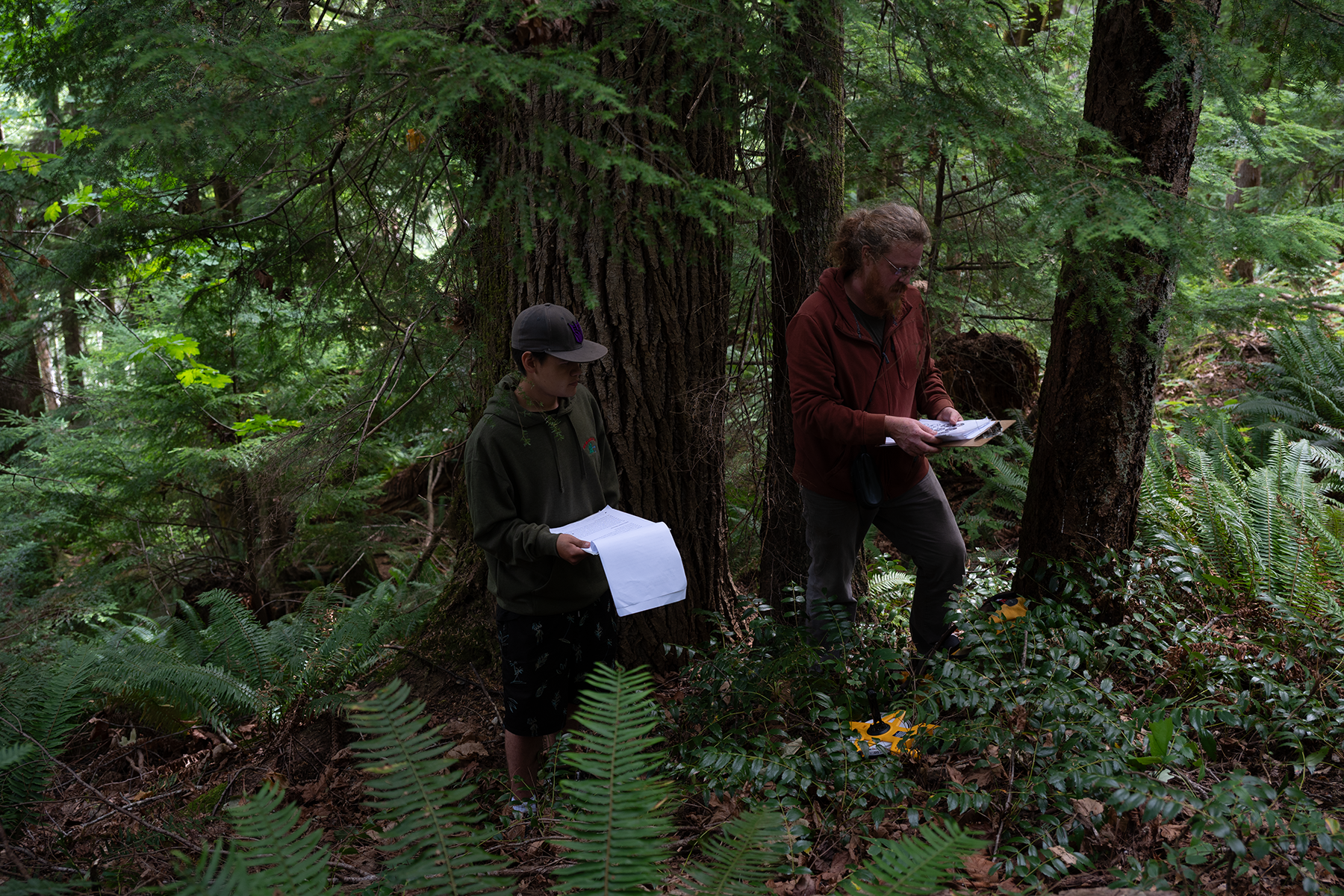
Hilliar and the two youth participants led a public tour to demonstrate how trails could be laid throughout the property. (Jeannie Lin / CHLY 101.7FM)
The Comox Valley Land Trust is considering the future of a property left to the public by a hermit.
On July 10, participants were invited to tour the diverse ecosystems around the 27 acre Oyster River Hermitage. Located near Catherwood road, the hermitage was once home to the late Father Charles Brandt, a Catholic priest, hermit, and environmentalist. who lived there for 50 years. The tour was led by guides from the Youth and Ecological Restoration (YER) program, which engages youth in ecological restoration and conservation projects in the Comox Valley. Graham Hilliar coordinates the program.
“I hope that it's a space where nature can remain nature and remain at peace, but have an opportunity for the public to come and enjoy that nature as well, and realize that it's part of our community as well, and we need to be gentle on it,” said Hilliar.
Prior to passing in 2020, in 2019, Father Charles Brandt placed a conservation covenant on the property with the Comox Valley Land Trust to ensure it would remain protected as a nature park in perpetuity. Four years later the property became an official Comox Valley Regional District park.
“Father Charles Brandt was a Catholic monk. He found peace and solace in nature and wanted his greater community to experience the same thing and feel as passionate about nature as he did,” said Hilliar.
Although the property is a CVRD park, it has not yet been developed with trails or signage. As part of the project, two participants in the Youth and Ecological Restoration program spent a week researching the property alongside a biologist hired by the CVRD. The group studied the site's ecosystems and explored how a trail network could be developed while protecting the environment.
“And so the Comox Valley Regional District sponsored the research that was done here this week by the youths and the biologist. And I think the youth did a great job, on their tour demonstrating to the public how this property could be used by everyone in a respectful way,” said Hilliar.
Hilliar and the two youth participants led a public tour to demonstrate how trails could be laid throughout the property. Along the way, they highlighted the land’s diverse ecosystems, including mature and young forest stands and a variety of native plant species.
Hilliar said preserving properties like this is important.
“It's really important in this day and age to have lands put aside that are not to be developed or cleared, especially a property like this with some mature forest on it that's right along the Oyster River. And with so many different forest types and microclimates within one 28-acre property, it's a pretty special place that he left the community.”
Mark Harrison is the manager of parks at CVRD recreation services. He said that the park is relatively new, and that there are no imminent plans to develop it, largely due to resource constraints.
“We're holding it as a land holding, but we're not actively managing the park. Once we enter into a management planning process, and that management planning process really looks at the environmental factors that are there. So, you know, what's important in terms of ecology, biodiversity, wildlife, all those kinds of things,” said Harrison.
Harrison said in addition to environmental planning, other factors such as recreational potential and adjacent land uses, are also taken into consideration. He said a general management plan is required before making any site planning of a public park.
“So there's a whole bunch of kind of information gathering as well as inventory gathering where we look at what's on the site in terms of tree canopy, in terms of slope, all those kind of things, and we end up with this large baseline for the park. And then we get engagement input for the park, and from that we end up with usually a general management plan for the park,” said Harrison.
According to Harrison, there is no timeline on when this plan will happen for the property. Visitors can learn more about the Oyster River Hermitage by visiting the Brandt Oyster River Hermitage Society at charlesbrandt.ca.
Funding Note: This story was produced with funding support from the Local Journalism Initiative, administered by the Community Radio Fund of Canada.
Newsroom Ethics • About our Newsroom • Report an Error • Corrections & Clarifications