
Rally in Courtenay calls for federal funding support for BC Ferries
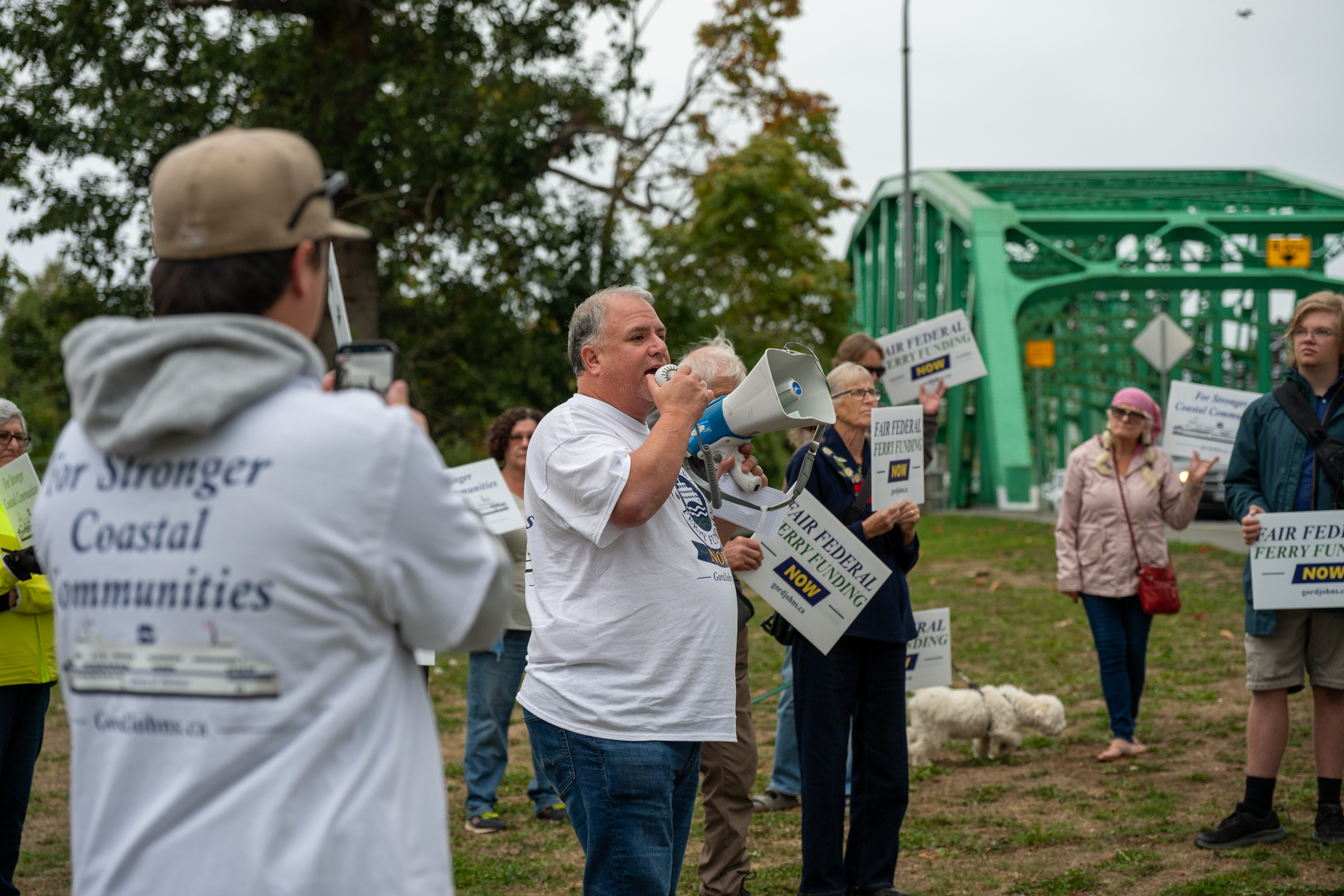
Courtenay-Alberni MP Gord Johns is calling for increased federal support of BC Ferries. The Courtenay rally took place at Simms Park Monday afternoon. (Jeannie Lin / CHLY 101.7 FM)
Comox Valley residents gathered at Simms Park on Monday as part of a campaign calling for increased federal funding for BC Ferries.
Comox resident Pat Guillo said he participated in the rally to support people whose jobs rely on the ferry system.
“It's just, you're used to going back and forth and, you know, sometimes we have to get over there. There's a lot of jobs that are reliant on people going back and forth. Because where I worked, for 43 years, I was going back and forth. And yeah, and they're still here,” said Guillo.
Courtenay-Alberni MP Gord Johns is leading the campaign to receive what he calls fair federal funding for the province’s ferry system.
“On the East Coast they get, basically 43 per cent of their ferry, operating costs are covered by the federal government, and in British Columbia it's only 3 per cent. So, you know, it's inequitable, it's unfair, it's based on old agreements that are outdated and it's time for it to be reviewed and revisited. People in British Columbia, just like Atlantic Canada, pay the same amount of taxes and we're not saying that they should get any less funding, but we're saying that we should get more and it should be more fair,” said Johns.
Johns said BC Ferries received about $37.8 million in federal support last year, while Marine Atlantic received $182.5 million.
“We can look at Atlantic provinces, and per capita, they're getting about $125 a resident, versus $6 in British Columbia, for example, and that's not fair. And it's based on constitutional agreements that were dated over 150 years ago,” said Johns.
Johns said the funding gap is largely tied to the different structures of the two ferry systems. Marine Atlantic is a federal Crown corporation, while BC Ferries operates under the provincial government. He argued that Ottawa uses outdated agreements to determine funding.
He also said ferry service is particularly important for Vancouver Island communities. Johns said Vancouver Island’s population is at almost a million people, larger than the populations of Newfoundland and Labrador, Prince Edward Island and New Brunswick, and comparable to that of Nova Scotia.
“There needs to be a reality that reflects modern reality and that funding needs to be recalculated, so that there's fairness. Ferries are critical in terms of connecting people to work, healthcare, education, their family, and economic opportunities. And all costs of goods are impacted by ferry transportation,” said Johns.
The campaign includes a parliamentary petition calling for changes to the way BC Ferries is funded. Currently, the petition has more than 7,000 signatures. The goal is 10,000 by the end of September.
Johns said BC Ferries has warned that, without additional government funding, ferry users could face fare increases of at least 30 per cent by 2028.
Johns said rising ferry costs can also affect the cost of living in coastal communities.
“All the goods and services that come to your community are ferry-related. You know, as costs of the ferries go up, so does inflation. It drives inflation on Vancouver Island and coastal communities, and it's critical that we get fair federal support when it comes to their contribution from the federal government to operate our ferries, or we're gonna see a cost-of-living crisis skyrocket,” said Johns.
Guillo said rising ferry fares undermines the original purpose of the ferry system.
“The ferry fleet originally came in, W.A.C. Bennett, way back in 1960, '61, somewhere around there, was to tie the two economies of Vancouver Island and the mainland together, make it one. And as the ferry rates go up, it's not working out that way,” said Guillo.
The Courtenay rally was one of several events being held across Vancouver Island and Vancouver this week, with the final stop in Victoria on Thursday.
Funding Note: This story was produced with funding support from the Local Journalism Initiative, administered by the Community Radio Fund of Canada.
Newsroom Ethics • About our Newsroom • Report an Error • Corrections & Clarifications