
Comox advances 721 Lazo Road rezoning with two conditions
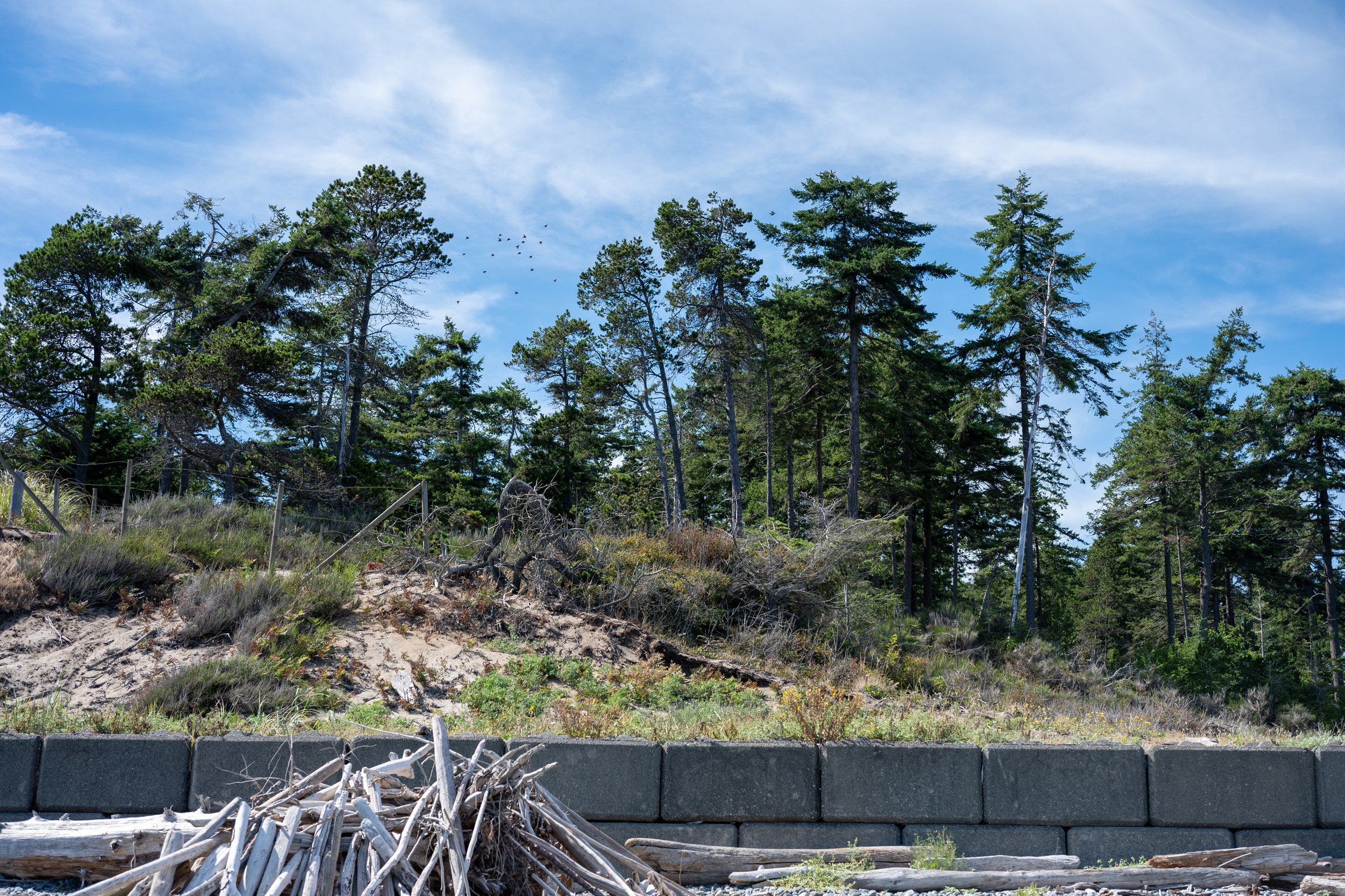
The view of the property from the waterfront. 721 Lazo road is undergoing a rezoning process. (Jeannie Lin / CHLY 101.7 FM)
The Town of Comox is moving ahead with the rezoning of 721 Lazo Road, after months of public discussion and technical reviews. According to the Town of Comox, the decision was made to balance environmental protection with the interests of the community.
At a regular council meeting on August 5th, Comox Council gave third reading to the proposed rezoning of 721 Lazo Road. At the reading, council added two new conditions before the rezoning can be adopted. First, the Town will engage an independent environmental report to review the project and confirm that it complies with all Provincial and Federal environmental laws. Second, all required development permits, which include a detailed environmental study, must be approved by council before the zoning bylaw can be adopted.
“So far, we've released about 180 pages of detailed technical studies that go over the environmental sensitivity of the area, the flood plains, the geotech. And in the council meeting at the most recent time that council took a look at this, they decided that they would like to help and ensure that this project is going ahead according to environmental regulations. So they have asked for another environmental review to be done on the site by a third party that's going to be funded by the town,” said Town of Comox Chief Administrative Officer Jordan Wall.
Wall said that these two conditions will ensure the development complies with environmental regulations.
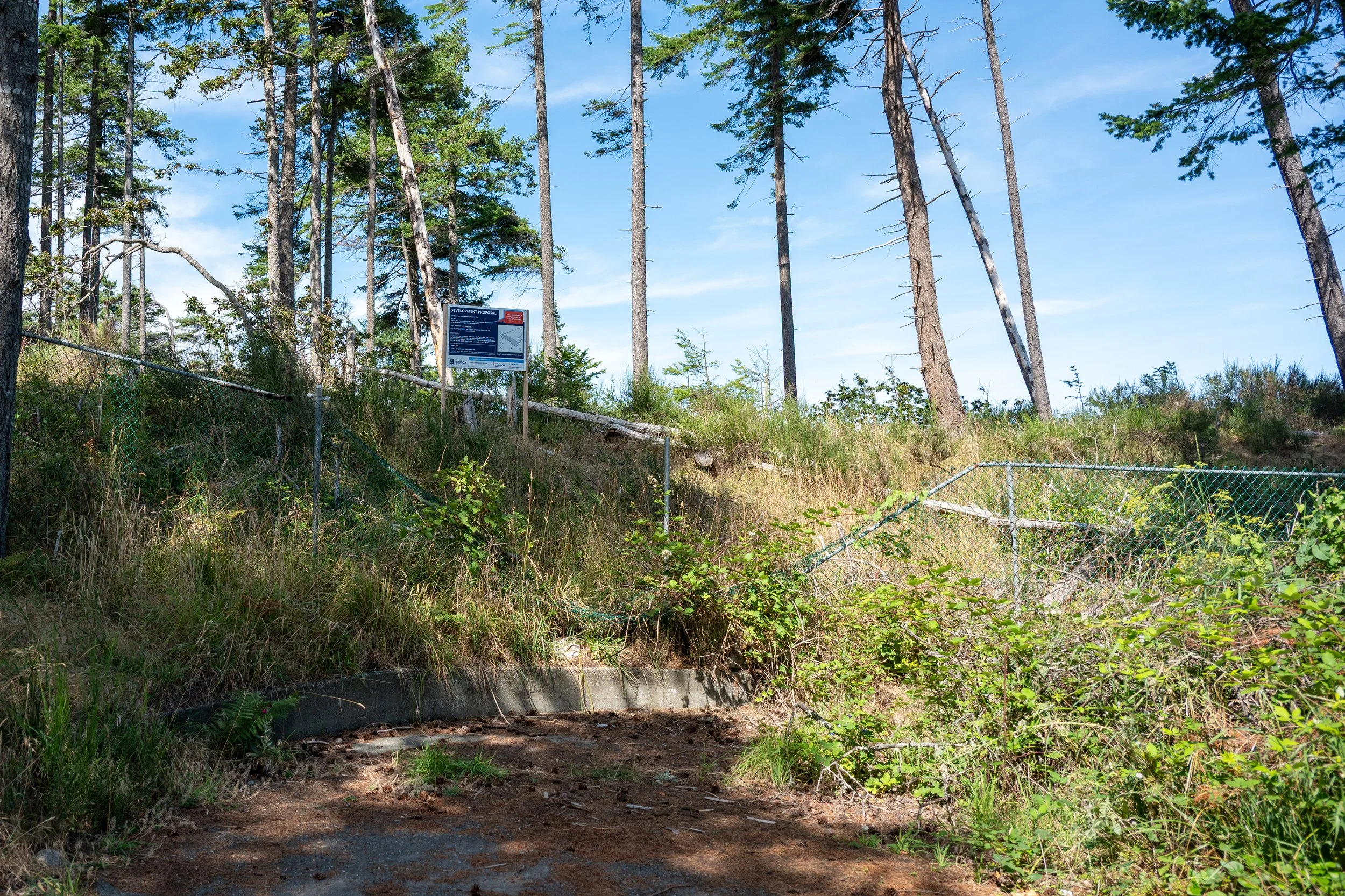
According to Kelvin Hummeny, the sign for the proposed rezoning went up in March. (Jeannie Lin / CHLY 101.7 FM)
“These are just two additional safeguards to ensure that if this development does go ahead, and there’s a number of questions left unanswered as to how the site can be constructed in a way that complies with all needed regulations, just two additional safeguards to ensure that nothing happens on it without us knowing positively that it can be done properly,” said Wall.
The 2.3 hectare privately-owned waterfront property is located near Point Holmes. It contains environmentally sensitive features, including Garry oak and sand dune ecosystems, and eagle and heron nesting habitats. Because of the ecological importance of the site, the proposed rezoning has been a widely debated issue for council and residents in the area.
Kelvin Humenny is a resident of the area and part of the Radford Beach Neighbourhood Association. He spoke of the sensitive nature of the ecosystems.
“This piece of land has everything from mature firs all the way down to the little trees that people sometimes don't notice, the Garry oaks. But the Garry oaks are everywhere. There are Garry oaks on Andrew Avenue that bleed onto the road closer than anything will be on the existing driveway currently,” said Humenny.
The applicant is seeking to change the existing Cape Lazo Residential Zoning (RC-L) to Comprehensive Development (CD) zoning. The change would allow the property to be developed into six lots rather than the four lots permitted under the current zoning. According to CAO Wall, these zoning changes would reduce the size and environmental impact of future homes.
“We are also, on the lots that are going to be developed, done a lot of work to try and minimize the environmental impact. So we have done things in this comprehensive development zone like increasing setbacks. We've reduced the building footprints. We've limited house sizes. You're not allowed to have a coach house on there because that would create more impact. We've reduced the type of businesses, like home occupations, that can happen on it. So we have done a lot of work to try and make sure that not only are we protecting this really valuable forest on the site, again, 65 per cent of it, but also to ensure that the lots are having the least amount of environmental impact, and we're having a smaller impact on the neighbourhood,” said Wall.
In return for the zoning amendment, the owner would allow the Town of Comox to permanently protect 1.3 hectares of property, or approximately 65 per cent of the property as publicly owned parkland, preserving Garry oak habitat, eagle nesting habitat and other ecological features.
Kathleen Duffield is also part of the Radford Beach Neighbourhood Association, which had put forward their own proposals for this development.
“We had proposed, had come up with a series of alternate configurations. The one that was sent to council wasn't the first iteration that had been prepared. A proposal for smaller lots than those set out in the proponent's configuration was put forward. Alteration of the location of the lots was put forward. We took the view based on the reading of the reports that there was going to be loss of the older forest in order to place utility services, various utility services, and it turned out, just the waterline. Our view was that if the right of way was gonna be carved out to allow for the waterline and there was gonna be loss of trees, then perhaps a better approach would be to cluster the lots in a way that would preserve the southern bluffs on the property and leave a contiguous wildlife corridor that consumes all of the ecosystems on the property,” said Duffield.
Duffield said that there were multiple proposals put forward by the neighbourhood association, and the goal is to work collaboratively with all parties involved.
“Part of this was a function of the process, and the town's processes have evolved over time with changes in provincial legislation. And so, we had a notion that if we could just work cooperatively with the parties involved, you know, the question in my mind was whether the existing configuration was optimal preservation of the environment, knowing that that property has hit so many of the development permit area categories within the OCP,” said Duffield.
According to the CAO, Comox Council did not support the alternative proposals, stating that they would not have provided the environmental benefits suggested and could instead have resulted in greater impacts on nearby habitats. Wall explained further.
“So this really comes down to a couple alternate configurations that the neighborhood has put forward, that they would like to see this site developed on rather than the one that the town is moving ahead with. And it's certainly things that the town did take a look at. But when we took a look at it and we overlaid the desired development scenarios that had been put forward to us on the sensitive ecosystem map, what we found is that these alternative proposals would result in more tree removal. It would eliminate big chunks of Garry oak stands. It would be right next to eagle nesting territory. And so what the town is doing in moving forward with this proposal is choosing one that actually results in less tree removal, has more tree protection, will protect more Garry oaks,” said Wall.
Humenny said he wants to see development done in a way that minimizes impacts on the environment and surrounding community.
“Our goal would be to have the least impact on our neighborhood and the least impact on the environment with this development, not to oppose it completely. We understand there needs to be more homes and owners have the right to develop their land when they have large land, but just do it right,” said Hummenny.
Duffield said the neighbourhood wants to find a balance between development and preserving as much of the property's ecological value as possible.
“There's no question that development of the lot is gonna result in the loss of something somewhere. I mean, that's just a fact. So, it comes back to, it would be helpful if it would come back to a discussion amongst ideally environmental scientists to secure an opinion about, you know, what is the relative importance of the bluffs, and is it significant to retain what remains there? If it's possible to do that while still meeting the proponents' desire of, as it relates to their development, and if it's still possible to do that while complying with the OCP for the town,” said Duffield.
The Town ultimately concluded that the proposed rezoning, along with the additional environmental conditions, provided the best overall balance between the environmental impacts of development and permanently protecting ecologically sensitive land. If the project meets all of the environmental requirements imposed by council, the area will become a public nature park and remain protected for future generations.
No date is yet set for final adoption of the zoning bylaw.
Funding Note: This story was produced with funding support from the Local Journalism Initiative, administered by the Community Radio Fund of Canada.
Newsroom Ethics • About our Newsroom • Report an Error • Corrections & Clarifications