
Forest Flowers is the City of Nanaimo’s first piece of Temporary Public Art for 2026
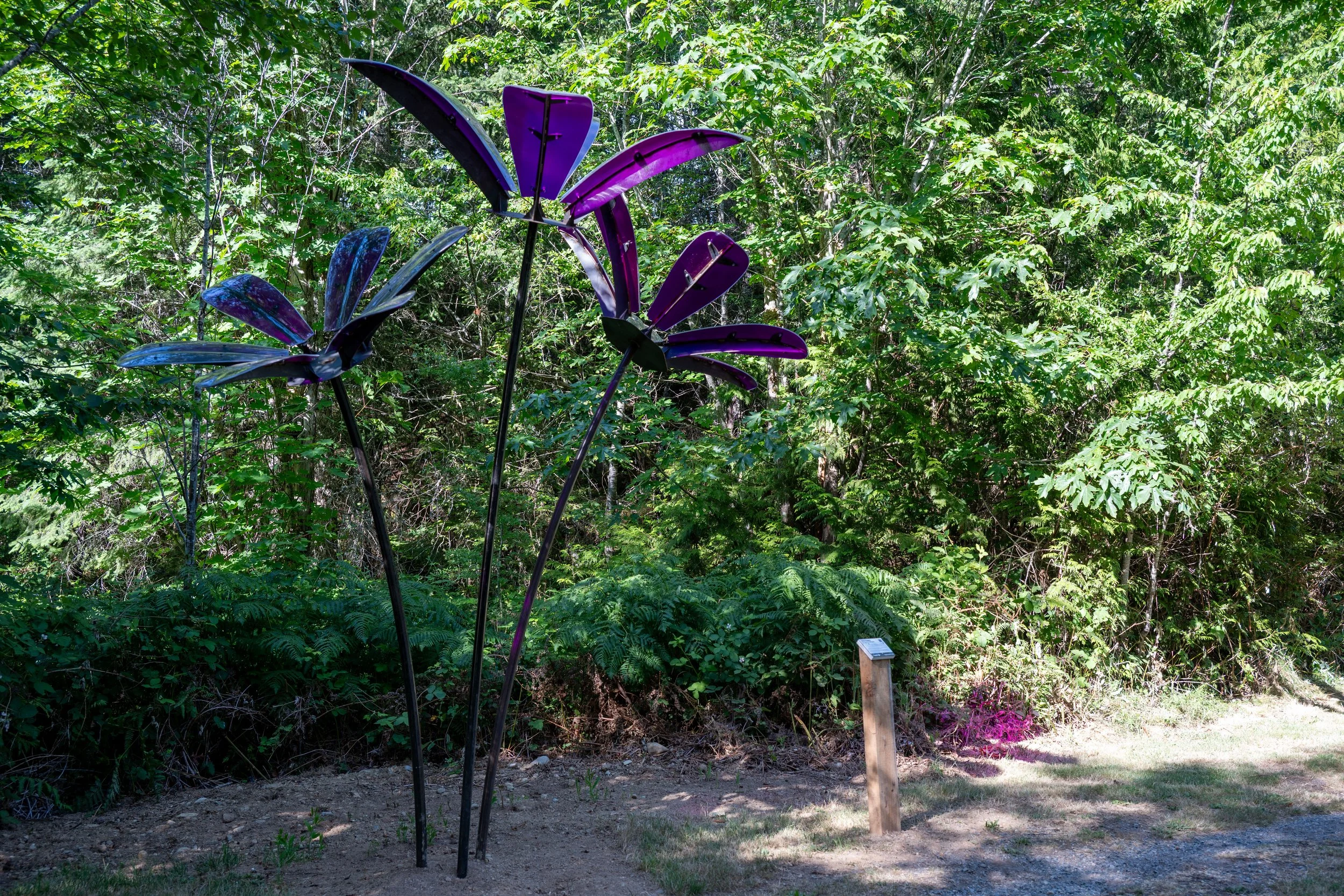
The new sculpture is located at Kinette Evergreen Park on Ninth Street. The project was made to celebrate the native Nanaimo flower, the Crown Brodiaea. (Luis Zablah/CHLY 101.7FM)
Forest Flowers by local artists Eliza Gardiner and Isaiah Kingdon, part of Nanaimo’s Temporary Public Art Program, has been unveiled. The new sculpture is located at Kinette Evergreen Park on Ninth Street. The project was made to celebrate the native Nanaimo flower, the Crown Brodiaea.
Also known as the Brodiaea Coronaria, Crown Brodiaea is a herb with 10 to 40 centimetres stems and a funnel shaped violet purple flower. It is known to be found around grassy marine lowlands at Vancouver Island and the Harewood Plains of Nanaimo.

Isaiah Kingdon, co-creator of Forest Flowers, a temporary public art installation in Nanaimo's Kinette Evergreen Park as part of the City's Temporary Public Art Program (Isaiah Kingdon)
Initially revealed in a press release on January 14 of this year, the City of Nanaimo is now rolling out their planned Temporary Public Arts Program for 2026, with the goal of activating public spaces, and supporting artists. By installing creative art around Nanaimo for the community to enjoy and engage with, the City also gives space for artists to express themselves.
Artists who engage with the program propose an idea of any scale and creative direction to the City, who chooses from the submission what projects to move forward with. The program not only gives local artists the opportunity to show off their talents but it also supports the artistic process, by providing the resources needed for the development and eventual realization of the art.
CHLY spoke with Isaiah Kingdon, the artists behind Forest Flowers, on how the project came to be.
“It was actually my capstone project for school as well, so, like your capstone being the final project you choose in a program. I had just finished Digital Fabrication and Design through Selkirk College, and your capstone being a project of your choosing, and so when Eliza came to me, like everything just kind of worked out,” said Kingdon. “Yeah, we would have one day a week. I really had to push myself to get to finish this, which was awesome, but yeah, one day a week for 11 weeks, so I had 11 in-class days working on it, but then I would also work on it on weekends.”
The process required deep organization, turning the design into a real structure. Kingdon describes it as balancing artistic design decisions with engineering and structural feasibility. The artistic vision began with the idea of the sculpture appearing as an actual flower that seems to be coming out of the ground.
Kingdon explains how he managed to fulfill the artistic vision through logistical engineering.
“Yeah, so there's a concrete block in the ground, and then I used wedge anchor bolts to fasten a base plate to that, and then those flower stems sort of sleeve into that, and then there's three bolts, so it doesn't rotate or anything like that, and then buried it around, so it just looked like the flowers growing out of the ground.”
He later explained why the project was chosen to be installed in Nanaimo’s Kinnette Evergreen Park.
“I mean, the whole idea of the flowers to sort of make something that you walk by and kind of catches your eye and brings you joy, you know, and so you're walking through the park, and you just kind of see these big flowers, and you kind of stop and go, ‘Wow, what is that?’,” said Kingdon. “I think it was to kind of bring like a whimsical joy to the area, and sort of represent the landscape too.”
Kingdons’s work was made in partnership with Eliza Gardiner, a Vancouver Island University professor. Gardiner explained via email her involvement, coming up with the concept of the giant flowers, with Isaiah aiding with the know-how of the project with skills such as vacuum forming, CNC cutting, and digital design. This all combined to make the dream come true.
Kingdom comments on the experience behind working together with Gardiner on the sculpture.
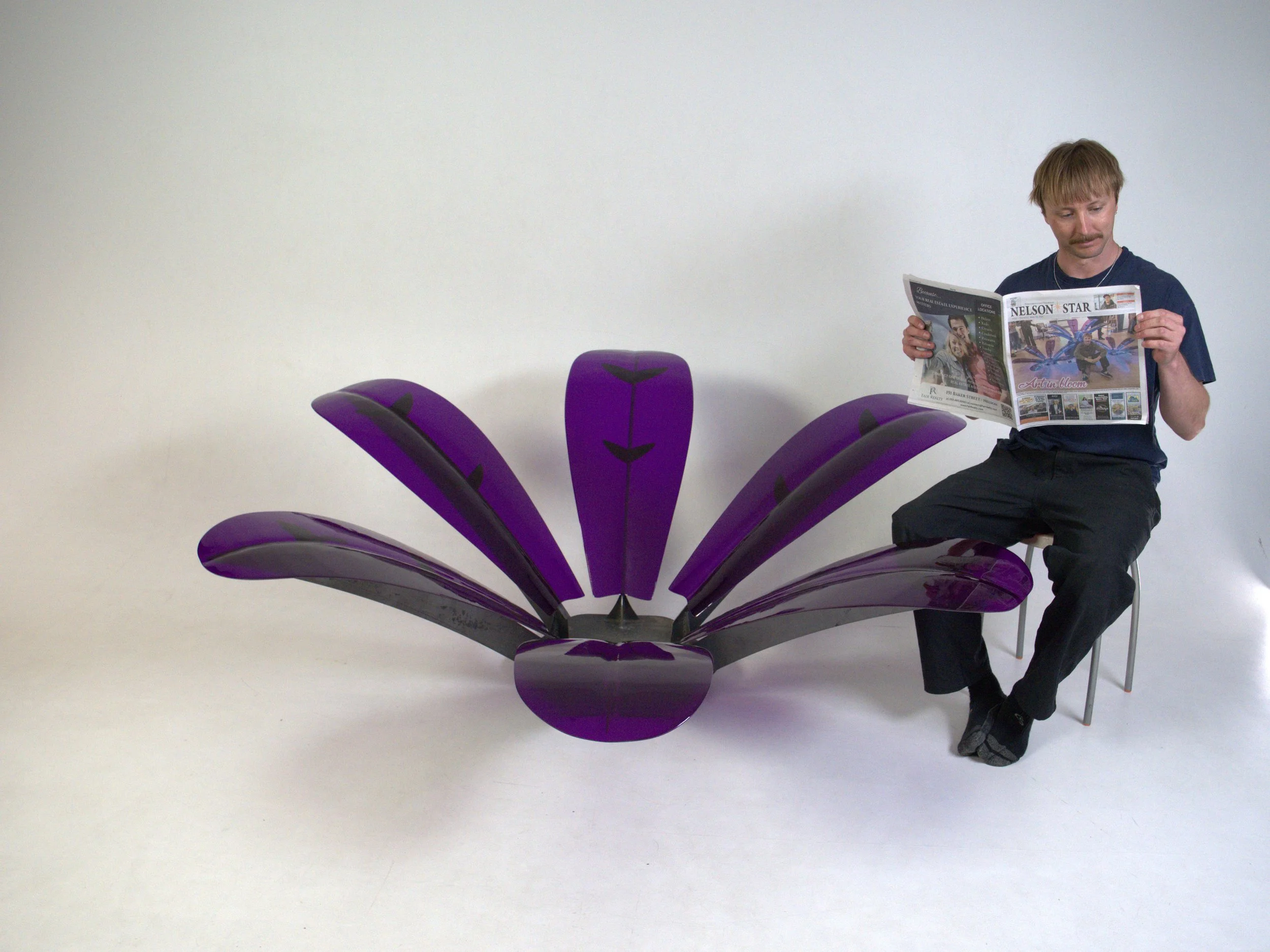
Kingdons’s work was made in partnership with Eliza Gardiner, a Vancouver Island University professor. (Isaiah Kingdon)
“Oh, she's fantastic. I love Eliza, yeah she’s great,” he said. “I think we worked really great together, as far as like bringing a vision, having an idea, bringing the vision, and her putting the trust in me that I will actually be able to pull this project off,” said Kingdon. “We talked all the time, and she was really good with inspiration and bringing it all together, and really did have a lot of trust in me that I could pull this thing off.”
More temporary art will be installed later this year, with the following piece being Encrustation: Barnacles of Belonging by Twyla Exner, a Canadian artist and educator. In her project Exner aims to create participatory public artwork where community members will help sculpt barnacle forms that will be installed on Nanaimo’s waterfront. Gardiner’s and Kingdon’s artistic sculpture will stay on display for the community to admire in Kinnette Evergreen Park up to 2031.
The City of Nanaimo is already opening their proposal inbox for next year's program with the deadline of October 18 at 11:59 PM.
Further information is available on the City of Nanaimo’s website.
Funding Note: This story was produced with funding support from the Local Journalism Initiative, administered by the Community Radio Fund of Canada.