
Comox Valley Water Services urges residents to be aware of water consumption habits during Watershed Awareness Week
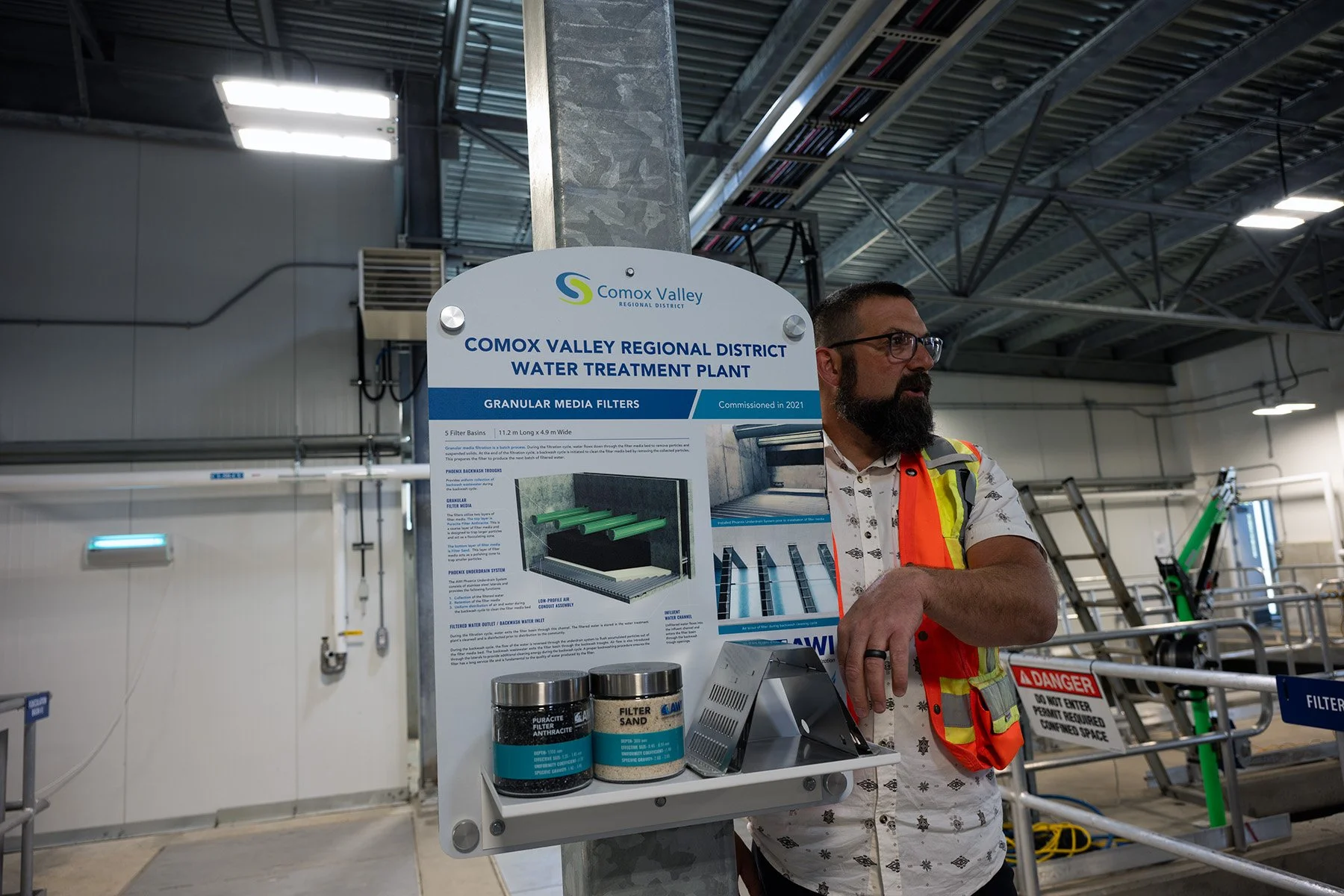
Mike Herschmiller is the manager of water services in the Comox Valley Regional District. He talked to CHLY about the importance of Watershed Awareness Week. (Jeannie Lin/CHLY 101.7fm)
The Comox Valley Regional District is making sure residents are well-informed about where their water comes from. Watershed Awareness Week runs from May 26. to 30. The initiative, now in its third year, aims to educate the public about the importance of protecting the water supply. The Comox Lake watershed provides clean drinking water for more than 50,000 residents in the region.
“The watershed is the source of our water supply. So ultimately, the better you can protect it and the better you can maintain its good functioning condition, the better your water quality is gonna get when it comes into your treatment facility,” said Mike Herschmiller, manager of water services in the Comox Valley Regional District.
According to Watersheds Canada, a watershed is an area of land which rain and snow falls into, which then all drains to the same basin. The Comox Lake watershed is a connected network of rivers, creeks and wetlands that feed into Comox Lake, the main supplier of water for Comox Valley residents. The regional district also manages the Black Creek-Oyster Bay, Graham Lake, Royston and Union Bay water systems. Throughout this week, the regional district is inviting the public to take guided tours, watch presentations and participate in family-friendly activities related to water conservation efforts.
Christina Willard-Stepan is a creator of the Connected by Water project, which has a goal of building community engagement to support water conservation efforts. She talked about how the current threats to the Comox Lake watershed can be mitigated.
“ There are certain threats that have been identified in our watershed right now. Some really key ones are the drought and fire protection. And that means making sure that you're not having fires outside of when you're allowed to. In fact, in the Comox Lake watershed area, the only sanctioned places to have campfires when there's not a ban on, are the two campsites. Making sure that motorized vehicles aren't trucking through the forest and sparking fires. So fire protection is really important this year with the combination of drought and us knowing that's a threat to our watershed. And then when we go on water restrictions, listening to the rules and following them and not using more than your share,” said Willard-Stepan.
Willard-Stepan explained the impacts of climate change on the Comox Lake watershed.
“ I think in terms of climate impacts on our entire watershed, we're definitely noticing less snowpack in the winter. Snowpack is technically a lot of our water storage in the Comox Valley. We're noticing climate change effects in forests and ecosystems and creek levels in general. And so just people having an awareness of that in general so that they take care when they're on the land,” said Willard-Stepan.
In February, the Ministry of Water, Land and Resource Stewardship, found that Vancouver Island saw lower than normal snowpack in the winter of 2026, at just 39 per cent of normal. Caitlin Pierzchalski is the executive director of Project Watershed, which focuses on restoring sensitive habitats. She explained why the low snowpack matters for the water supply.
“There's a general transition in a lot of areas away from a snowpack regime to a more rain-based regime. So in the wintertime and into the spring, instead of there being a lot of snow that's deposited into the mountains, you'll be seeing just a shift towards a more rain-based regime. So that means there is less of that maintained snowpack into the spring and summer that provides those baseflows. So it just means there's just a shift in the regime, which changes where and when water is available,” said Pierzchalski.
Pierzchalski says it’s important to be mindful of our consumption habits.
“There are places that are less affected by drought and do have substantial water resources. You know, the Great Lakes are very, very big. But in other areas where we're really reliant on any individual basin for our drinking water we're definitely a little bit more at risk. You know, for the most part, our water comes from Comox Lake. So the health of Comox Lake is really critical for our clean water and our drinking water supply. I think it's really important that people understand generally, where our water comes from and the actions and things that are happening in the landscape around the lake and the effects that those have on our clean water,” said Pierzchalski.
Herschmiller says the simplest method to conserve water is to use only what you need.
“In the wintertime, the Comox Valley uses about 20 million litres of water a day, of drinking water. In the summertime, that can balloon to 50 million litres. So that's an extra 30 million litres above what we'd call your base usage. So that number is other stuff. It's outdoor, it's generally sprinklering lawns, it's washing driveways, washing houses. A lot of it is required and some can be considered important use, but a lot of it is not required use. So, in the summertime when that goes up, we have to make sure our pipes are bigger, our pumps are bigger, our reservoirs are bigger. We're using more chemicals to disinfect. So, there's a whole bunch of other kinds of reasons for why we wanna reduce the water, but really, in the summertime is when the environment needs it more than anything as well. So, the more we're taking out of the environment, the less is in the river for the fishes, and for just the environmental needs of the ecosystem,” said Herschmiller.
Herschmiller said one goal of Watershed Awareness Week is for people to understand how the water system works.
“People have gotta understand that we live in a rainforest. We have lots of rain, but we don't capture all that. The amount of water to store in the lake is finite. When people understand the process, it's easier for them to adhere to guidelines and kind of follow those things that are put in place to try to protect the resource,” said Herschmiller.
Comox Valley Regional District announced that stage two of water restrictions will be in effect on June 4. The new restrictions will limit lawn and garden sprinkling to only three hours a day, for two days a week. More information can be found online at comoxvalleyrd.ca.
Funding Note: This story was produced with funding support from the Local Journalism Initiative, administered by the Community Radio Fund of Canada.