
Climate action hub holds election forum for City of Nanaimo candidates
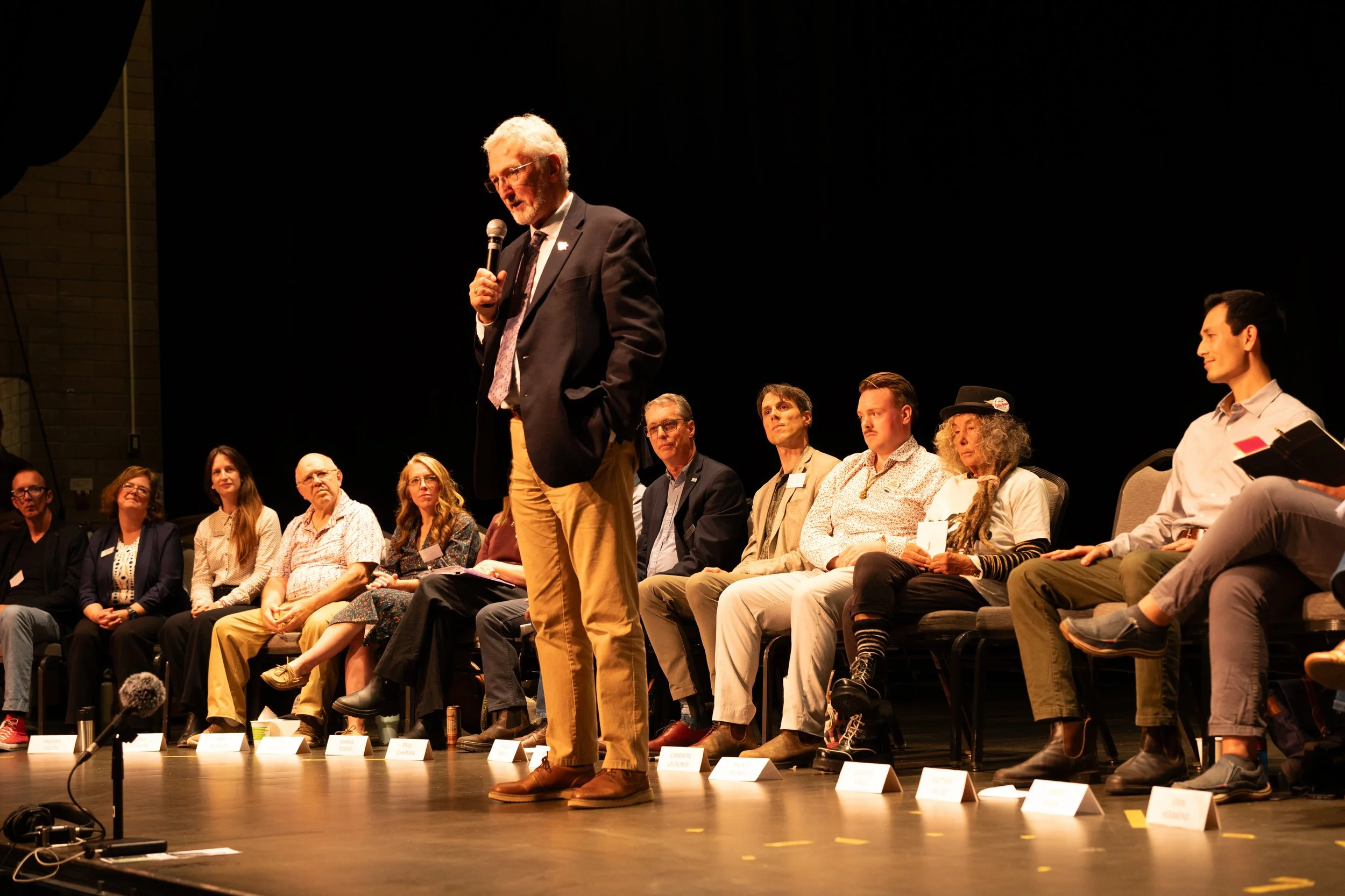
With Nanaimo having declared a climate emergency in 2019 and the municipal election approaching, the NCAH organized a live candidate forum for the community to hear what climate actions candidates would support if elected. (Photo by Jesse Woodward / CHLY 101.7FM)
Candidates for Nanaimo City Council were candid on climate change and the environment this past Tuesday. The Nanaimo Climate Action Hub (NCAH) organized a candidate forum at Beban Park Social Centre.
The Nanaimo Climate Action Hub (NCAH), is a membership led non profit organization founded in 2020 and incorporated in B.C in 2021. It’s run by a volunteer board, the group focuses on community based climate action and has around 20 members. With Nanaimo having declared a climate emergency in 2019 and the municipal election approaching, the NCAH organized a live candidate forum for the community to hear what climate actions candidates would support if elected.
Kevin Lindsay, Chair of the board of directors of the NCAH set the tone for the event.
“We're dealing with a context right now that is a backdrop and right in our faces, and really determining so much of what things look like for future generations. But not just future generations, it really influences what happens now. I was talking to one of the candidates tonight who is experiencing some of the effects of wildfire smoke and that's something we can't ignore,” said Lindsay. “Fifty percent of emissions can actually be influenced at the local municipal level. The decisions that are made in our local government, uh, go a long way in determining the degree to which we emit greenhouse gases.”
The event had recurring themes such as data centres, water, active transportation, industrial rezoning at Cable Bay and future plans for the city relating to resilience in the face of climate change.
Incumbent councillor Hilary Eastmure spoke on her position on data centres and their water usage.
“I have brought forward a motion looking at data center water usage so that if we ever get another rezoning application, we'll have to know how much water it uses up front. That's why I voted against the last one.”
City council candidate Jackie Bolen addressed data centres in her opening speech, as well as other pressing issues for her.
“Global warming and food security are the most pressing issues of our time, and I plan to vote on all matters in light of these things. If we don't have healthy land, air, and water, we essentially have nothing. I will never vote in favor of data centers.”
The forum asked questions to individual candidates, with opportunity for other candidates to comment via a wildcard system. Each candidate was given a limited amount of wildcards to use.
Leonard Krog, incumbent mayor, said development permits for the data centre are already in place and it’s up to the province to decide whether or not the project will move ahead.
“The basic issue that confronts us now is whether or not the province will in fact allow the electricity that we needed to operate the data center. The data centre, as proposed, will use no more water than a car wash or an average sized apartment building.”
The 22 attending candidates each had limited time to discuss their plans to address environmental issues found in Nanaimo. A constant theme was transportation, which included the use of buses, walking, cycling and more.
Mathew Miller, a first time candidate for Nanaimo City Council, detailed a plan for his campaign focusing on transportation.
“My three priorities for the city council and during my term will be improving access to primary healthcare, as well as increasing our network of transportation for the public, as well as the flexible childcare facilities for families that are working shift work and on weekends,” said Miller. “I'm really excited this evening to be able to share how those three priorities relate to the environment, especially public transportation, active transportation and so that we can reduce emissions and make our city safer for everyone who wants to use our streets, sidewalks, and parks.”
Miller’s excitement was just the beginning, with other candidates sharing his passion for Nanaimo’s transportation. Incumbent councilor Erin Hemmens, added to the dialogue detailing the current plan and how it will continue to grow.
“With City Plan, that's been pointed out by a couple of colleagues, we've moved from climate action being a standalone file to something that's actually embedded in everything we plan and do. We've adopted the highest level of the Zero Carbon Step Code and made significant investments in active transportation and transit, tackling our two biggest sources of community emissions.”
Richard Harlow, another first time candidate running for council, was especially passionate about the matter as a visually impaired citizen.
“I know that transportation is something that is really close to me because that's the only way that I'm gonna get around, public transportation and my own two feet. So with urban sprawl going to corners of Nanaimo, I wanna be able to address that with more increased transportation, to those regional areas.”
As the night went on, Cable Bay, known for its trail, and proposed rezoning was a recurring theme, with several candidates determined to preserve the area. First time council candidate Marnie Boers, kicked off the conversation addressing Cable Bay’s significance to the community.
“So, around Cable Bay, if it was to come back, which would be amazing because then we'd have a chance to build some more trust with community and show that we can have a transparent discussion,” said Boers. “I don't wanna lose that, those, those spaces. Once we lose it, it's gone. So, if it was to come back, I would protect it. I think the community has spoken, and that's as a job as a city councilor is to listen to what community wants and reflect that in decisions we make.”
Ben Geselbracht, incumbent councillor for the city, explained his previous actions towards Cable Bay in the area and spoke to how special the area is for Nanaimo locals and tourists.
“I've already voted against Cable Bay because the environmental protections weren't in place when it came back and after the public hearings. It moved forward anyhow to public hearing. And during the public hearing, we heard very clearly from the community that this is a very special place,” said Geselbracht. “It's a gift. You can go walk down and watch the orcas, and thousands of people visit this area. There's also already been heavy industrial in the area, um, which has had its impacts. And adding to that, irresponsibly is, we can't do that. And that's why I moved a motion that asked for greater protected lands, a greater buffer, protecting the mature forest that's there, and also narrowing, uh, any heavy emitting industry, not allowing that, uh, to be in there.”
Jackie Bolen, closed off the conversation.
“Here is the speech I gave at a Cable Bay hearing. Quote, "First of all, I'll never vote to rezone agricultural land for industrial uses." Here's the speech. Jobs come and go. Companies come and go. Old trees and Gary Oak ecosystems do not. Once they're destroyed and the land repurposed for other uses, they won't just grow back,” said Bolen. “This is a permanent decision. I feel a deep responsibility to leave the world in a better place, not just 10 or 20 years, but 500 or 1,000 years from now. What greater purpose do any of us really have but that? I fear we'll look back on decisions like this in 30 years or 50 years at the end of our lives and realize that we were on the wrong side of history,” said Bolen. “Buying a piece of land with the assumption that it can be rezoned is a poor business decision. Uh, future generations, uh, shouldn't have to be the ones that pay for that.”
After detailed equal discussions from the 22 candidates, the night closed off.
CHLY spoke with some in the audience to see what the community thought about the environmental forum for the would be city leaders.
At the beginning of the evening local resident Jay Kell shared what he was hoping to hear from candidates.
“I'm interested in how people present themselves, how, like, and how organized they are with their information. I'm never unswayable. I like the facts, the truth, and if somebody startles me with something, I try not to presume anything. So if I'm swayed one way, then so be it.”
Bryant Marshall is running for council, but was attending as an audience member. He shared what he hoped the candidates would cover.
“Solar power and wind power, using our amenities and the community and the city getting together and working a bigger plan for climate change and developing ways in which we can generate energy for our community and to lower our taxes, property taxes.”
The crowd was filled with environmentally passionate residents looking to hear the candidate's visions for the city in regards to the climate and environment. Ian Gartshore, a cyclist, was in attendance, and commented on what he took away from the event.
“Some of the folks that I've never met before, I was very impressed by as well, so that helps me to narrow my decision-making,” said Gartshore. “The whole topic about affordability is extremely important. I think the idea of people growing food on their property, which I am, is not a very realistic one because most people do not wanna put the hard work into it. But having the city developed so that people can access grocery stores and making land possible for those who do wanna grow, that makes a good idea too.”
The forum had a hefty turnout with just short of 200 attendees. Kevin Lindsay, one of the event’s head organizers, gave his perspective on the event.
“I think that we accomplished what we set out to accomplish. We wanted candidates to come and, you know, be real and not just get up there and spout platitudes and talk about their platform ad nauseum. I think we had some real conversation.”
Lindsay ponders on the questions the team behind the NCAH crafted for the candidates and shares what he believes attendees gained from the experience.
“I think that the questions that we designed were provocative enough and open-ended enough that it made the candidates think, and so we had a lot of really great responses, a lot of really well thought out and sometimes experience, you know, very much experience-informed responses to the questions that that we asked,” said Lindsay. “I think that while people may not be satisfied in all cases, with the answers they got from the candidates, they certainly they were witness to the perspectives and the plans that these candidates shared, and so that's a success if they walked away with that.”
Nanaimo's General Election will be held Saturday October 17, 2026. With advance voting days available October 7 and 14.
Further information is available on the City of Nanaimo’s official elections webpage.
Funding Note: This story was produced with funding support from the Local Journalism Initiative, administered by the Community Radio Fund of Canada.
Newsroom Ethics • About our Newsroom • Report an Error • Corrections & Clarifications