
Save Our Forests Comox Valley rallies in Courtenay to protect B.C.’s old-growth forests
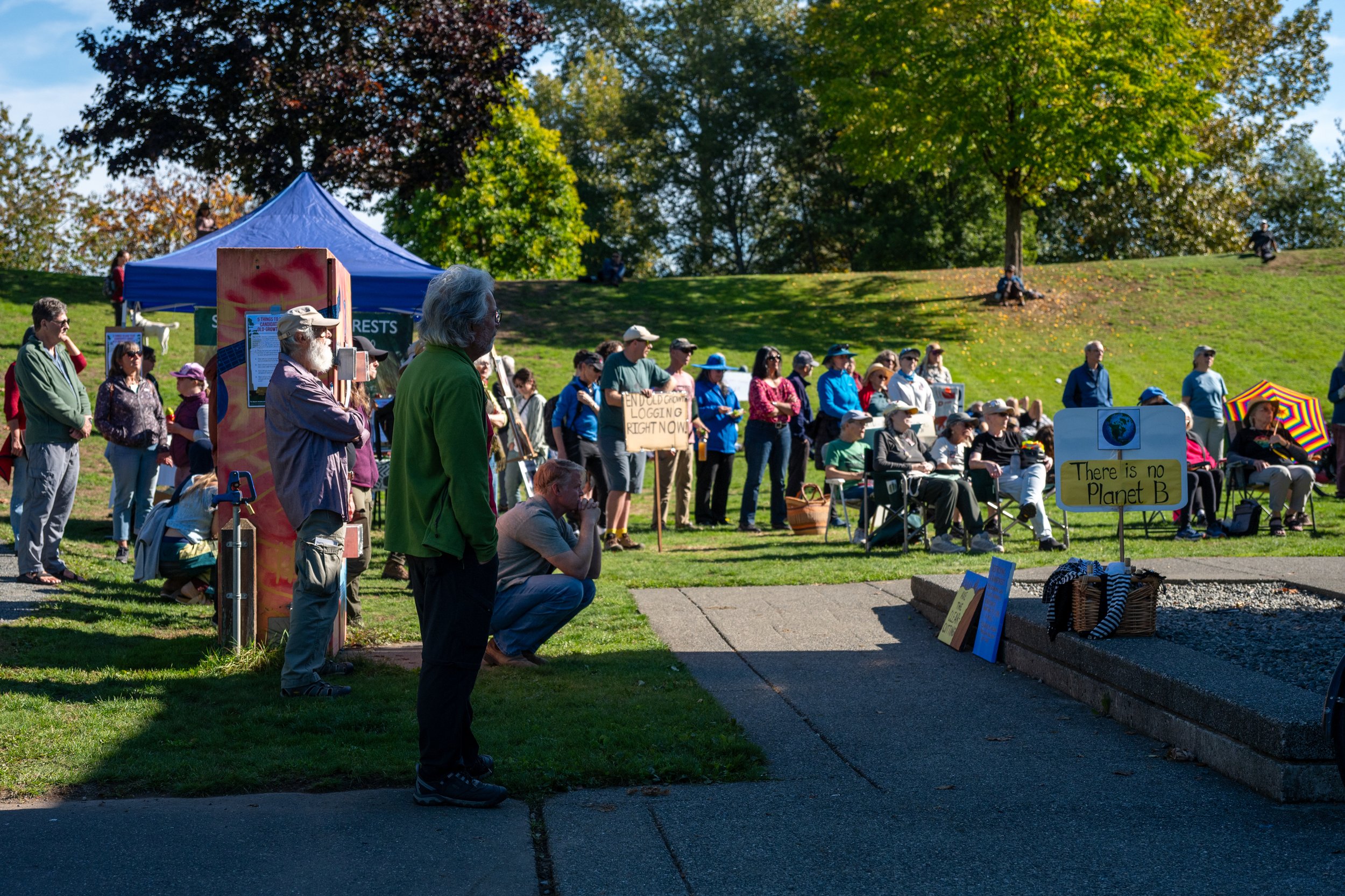
The Courtenay rally took place at Simms Park, organized by Save Our Forests Comox Valley. (Jeannie Lin / CHLY 101.7FM)
On Sunday October 4th, the Comox Valley community took part in Hands Off Old Growth, a province-wide rally calling for the protection of B.C.'s remaining old-growth forests.
Save Our Forests Comox Valley organized the local participating rally at Simms Park. Organizer Owen Enright said the rally is aimed at raising awareness about old-growth conservation, and putting the issue back on the agenda for the provincial government.
“The purpose of the rally is quite simple. It's ultimately to raise awareness for sensitive ecosystems in our province that are at risk of destruction through industrial logging practices, in a time where we see that biodiversity and ecosystem service loss around the world has never been higher,” said Enright.
The rally and participating organizations call on the B.C. government to follow through on previous commitments to protect old-growth forests. The rally was originally scheduled for the day before Premier Eby and MLAs returned to the Legislature for the fall session, but this fall’s election call put it in the middle of the campaign.
“It's to bring conservation concerns and management practices around old growth to the political arena, to hopefully influence decision-makers to implement progressive forest policy that both protects our unique old-growth forests here in B.C., but really plans for a sustainable logging industry that continues to provide jobs well into the future,” said Enright.
The rally focused on the province’s response to the 2020 Old Growth Strategic Review, an independent review that examined how B.C. manages and protects its remaining old-growth forests. It made 14 recommendations for changing the forest policy. The Province then introduced temporary logging deferrals in some old-growth areas.
Enright said the rally timing is important because these temporary logging deferrals are beginning to expire.
“It was a study done in 2020 and it was issued to the public about the sensitivity of old growth ecosystems, and they're important to us. Now, in that report, it also stated and identified key biodiversity areas that must be protected immediately. This led to a series of deferrals that we've seen unrolled or rolled out over the last number of years. But those deferrals are expiring. They were extended for a number of years, and now they're coming to an end,” said Enright.
Enright said some of those forests are at risk of logging again, and he wants the province to permanently protect at least some of the areas identified in the review.
“And it's seemingly classic government semantics where they issue a report. It provides recommendations. They make a slapstick decision like deferrals where, okay, we're not logging here for the next period of time, and we'll figure out something to do. But we see now that those forests that were deferred are open to logging again. So really what we need to do is say those deferral areas that were identified in the Old Growth Strategic Review, a portion at least of those must be protected, if we are to retain those benefits of old growth forests,” said Enright.
According to The Wilderness Committee, 20 per cent of forested land in B.C. remains as old-growth. The Ancient Forest Alliance says that on Vancouver Island and the Southwest mainland, over 80 per cent of the productive old-growth forests have been logged.
Enright said losing more could have consequences for climate mitigation and local ecosystems.
“You can't deny the fact of its benefit to climate mitigation. So through carbon storage, it's important to note that in old-growth forests, that storage is two to three times more per hectare than second-growth. And then they also provide huge benefits to biodiversity and ecosystem health, as their complex forest structure provides habitat for multiple endangered species. And there's the ecosystem service side as well that these forests provide as they naturally regulate local water cycles. They filter drinking water. They prevent soil erosion. And they also buffer communities against extreme weather such as floods, droughts, and wildfires,” said Enright.
Rallies were held simultaneously in other locations such as Nelson, Vernon, Revelstoke, and Victoria, calling for conservation efforts to be put on the political agenda.
“They said this is something that we are gonna consider when managing our forests. And they haven't upheld that. They've just used it as a way, a point of leverage to make it look like they are doing something, and now they aren't upholding those promises to actually protect those forests,” said Enright.
Enright said the issue ultimately comes down to protecting ecosystems that communities rely on.
“The air we breathe, the water we drink, the food we eat, it all comes from the earth. And if we destroy that, we ultimately destroy ourselves. And so it's, we must remember that old growth forests, amongst many other ecosystems, are simply a part of this delicate balance of life,” said Enright.
Enright encouraged communities across B.C. to learn more about the issue and be involved with local organizations. To learn more, follow Save our Forests Comox Valley on social media and at saveourforeststeam.org.
Funding Note: This story was produced with funding support from the Local Journalism Initiative, administered by the Community Radio Fund of Canada.
Newsroom Ethics • About our Newsroom • Report an Error • Corrections & Clarifications