
City of Nanaimo mayoral candidates Anne Marie Dryden and Brunie Brunie
Synopsis
Ahead of the October 17th local elections in British Columbia, Midcoast Morning spoke with each of the four candidates running for Mayor of Nanaimo. In this episode, former financial planner Anne Marie Dryden and multi time mayor and council candidate Brunie Brunie.
Transcript
Editor's Note: This transcript has been lightly edited for style, ie: filler words, stutter-starts, and repeated words have been removed.
—Transcript Start—
Announcer: The following is a project of our nonprofit newsroom. Support Midcoast Morning and local journalism today at chly.ca/donate. Local news doesn't survive without local support
—
Joe Pugh: Hello and welcome to Midcoast Morning. I'm Joe Pugh. On today's program, we hear from two of the candidates seeking to be mayor of Nanaimo.
—
Pugh: I am joined in the studio by Anne Marie Dryden. You are one of four people running to be the next mayor of Nanaimo. What prompted you to throw your hat in the ring?
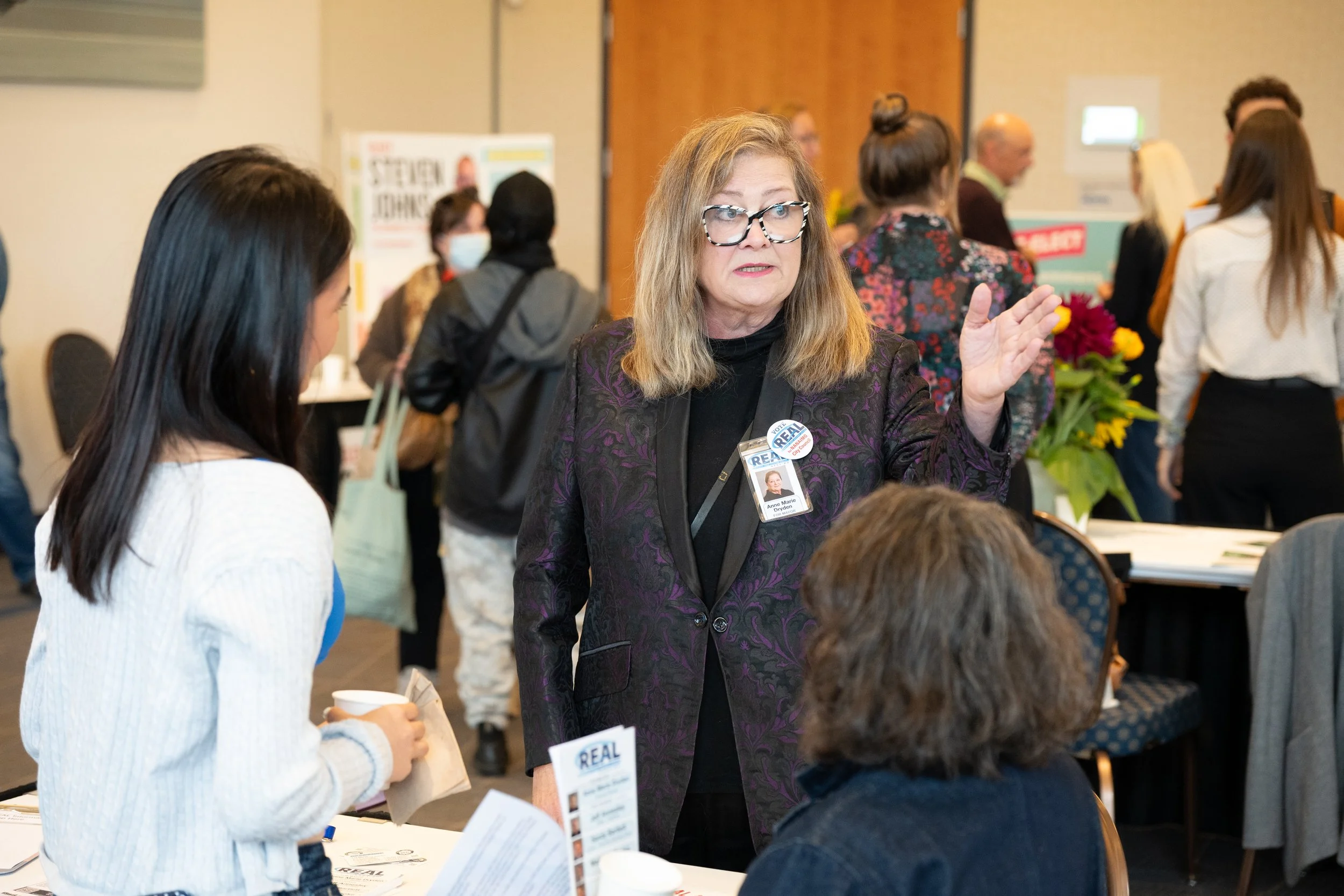
Anne Marie Dryden, REAL Nanaimo candidate for mayor at the Greater Nanaimo Chamber of Commerce candidates forum. (Jesse Woodward / CHLY 101.7FM)
Anne Marie Dryden: I've been reading so much and watching what's going on in the world, and I was at, coming to the end of my career where I'd probably be better to step away from it. My son took over my practice, and I found myself free to pursue fixing problems that we see around us. And I was thinking, how can I, what can I do?
I thought about writing a book, but that's a very slow process, and I felt that the problems were more urgent than that. And so I joined one of the groups in Nanaimo who were also concerned with the state of the world, and that group, with over 3,000 people in it, asked me if I would consider running for mayor.
Then I thought, running for mayor is a way I can actually do some real good in our city, but also even on a bigger scale. I want to be the mayor, but I also want to form a c- a network of information between municipalities in British Columbia. I want to join together with many municipalities to specifically address some of the bad policies in the province as a united voice with some power
Pugh: So you're part of the REAL slate. It's my understanding that group was born out of the anti-AAP movement, opposing the project with the public works yard. Could you just tell me a little bit about how you came to be involved with the group? And you were talking about there, about maybe being asked to run for mayor, about your journey to being the mayoral candidate in that group as opposed to, say, a councillor.
Dryden: Yes, not many people are willing to take on the challenge of being mayor. I have a- an excellent skill set that lends itself really well to that role. I th- over three decades as a financial planner and a small business owner, I understand money.
I'm literate financially, and I felt like I could bring to the table what is really needed to get Nanaimo back on track and thriving again. We've seen s- it go downhill for eight years. I wanna turn that around.
Pugh: What exactly do you feel like are the most pressing issues that the city is facing, and what do you see as your role, if elected mayor, in addressing them?
Dryden: For me, one of the, if not the most pressing issue, is cleaning up our streets, helping the people who are unhoused, and getting drugs off the streets. If we can solve that one, it goes a long way to solving other ones and to promoting tourism in Nanaimo and also small businesses opening their doors. If businesses can feel safe downtown, business owners will open up and serve the public.
We can get more foot traffic through the downtown area. Fixing the most obvious problem that we're facing right now will solve a lot of other problems, and that's what I wanna do. I wanna get people off the street, help them find accommodations, get treatment, and that kind of thing.
Pugh: What do you see as the city's role in doing that? What do you propose to try and do from the city level?
Dryden: Some people, the current administration, for example, seem to think that it's the province's problem. I'm not about passing the buck in that way. Whenever I have decided to tackle something, I have tackled it with all I've got, and generally been successful in almost all the things I've really wanted to do, and I don't see this as being any different.
I believe the city has a role. I believe we have to reassess our priorities, and we have to allocate some funds to this problem because it will pay out, pay us back in spades when the economic growth reflects what we've done to clean up our city.
Pugh: You talk about maybe allocating some funds to address the problem. What do you see those going towards? We saw in the last term a drop-in centre for people to use, The Hub it was called, on Nicol St. Is that the kind of thing you're talking about, or what action do you see the city taking?
Dryden: I would like to see dry housing instead of wet housing. I've had the privilege of taking in over a dozen people coming out of recovery from addiction, and one thing I know from that experience is that being around actively using peers is not conducive to successful recovery.
People need to come out of recovery to a place where they're safe, where they can have enough food to eat, and support of other people also trying to stay clean. So I would see in my term as mayor introducing more dry housing and not so much wet housing. Also, I've been speaking to citizens who have residences near to wet housing facilities, and they are absolutely distraught because they look out their front window and see people using right on the street beside their fence.
They have sirens multiple times a week because of overdoses and firetrucks coming to respond to that. This has to stop. We have to find a way to serve the, taxpaying citizens of Nanaimo too, and I think they would be much more comfortable with a dry housing there than a wet housing.
Pugh: The current Nanaimo City Council pretty unanimously spent around a year advocating for a, a new supportive housing development that's gonna come on Terminal and Bryden to be a dry or sober recovery-oriented focused housing model. Do you feel like there is something different that you would do? It sounds like they're at least on that project have been advocating for that. Where do you see this going from there?
Dryden: I believe that they are implying it will be dry housing using clever words, but there is no actual commitment that I've been able to find that it will in fact be truly a dry housing facility.
I think it's great to create accommodations and get people off the street into housing, but I think that there's a bigger problem that we have to address, and that's the drugs on the street and the need for recovery for these people
Pugh: So you would like to see, if I'm getting this right, just more dry housing, and you would like to see something in the development of that housing … if you could just clarify a little more?
Dryden: Less—
Pugh: Like what the difference is between, like if the city council now is calling for something and they've got it, what you feel?
Dryden: I would like to see less wet housing, maybe no wet housing, and I would like to see more dry housing and more recovery options.
Pugh: In terms of other issues that the city is facing, your REAL slate was born out of this AAP process, the opposition to this AAP process to borrow money for, the creation of a, a new public works yard. Since then the province has changed the rules around borrowing, and that project is underway.
But what do you see as the way that you would like to handle a situation like that when the city staff come and say, “Hey, we've got this old building that's falling apart from the '60s. This is what we want to do about it,” or other kinds of similar scenarios? How do you envision handling that?
Dryden: I think it's abhorrent that the city would go through some backroom deals to raise the debt ceiling in order to push through a project that the citizens voiced loudly that they were opposed to. I don't think that we should be borrowing more. I think we should be instead trying to eliminate debt.
It's just a very expensive proposal, and the citizens don't want it. My plan as mayor is to listen to the people, to look to respond to the wishes of the people, and not to push through projects that are vanity projects or legacy projects or projects that a certain group favors to the detriment of the population as a whole.
Pugh: And you feel like the public works yard was one of those projects you're describing?
Dryden: I feel that the people have spoken, and we should listen to them. We shouldn't go behind their backs and create these deals with the province that we can incur more debt, in order to push through. And you have to wonder, if that project started at over, I think it was [a] $163 million project, and now it's been cut back to about a $78 million project, why was it so much in the first place?
Were they having gold taps on their plans? I don't know. Like, why, did it, why is it feasible to do it for less now that we've objected to do, to doing it for more? it should have come in at a reasonable cost right out of the gate. Maybe there wouldn't have been so much opposition then.
Pugh: What do you see as the city's role in shaping the future development of Nanaimo, in terms of housing, in terms of communities? Where do you see that going? How would you like to see the city developed as it grows over the next decade or so?
Dryden: What I would like to see is Nanaimo expand with more subdivisions, more neighbourhoods where families can own homes and children can have grass to play on, and we can expand the taxpayer base that way.
Instead of adding more tax to existing property owners, let's have more property owners sharing that tax burden. The city owns a lot of land, and we could expand the boundaries of the city, and we could build lots more houses, make them somewhat affordable. The city would get revenue by selling off the subdivided lots.
That would help offset some of the tax burden that we've placed on our citizens. It would give more houses for people to live in, and it would also encourage more business, m- businesses to open to service those neighbourhoods.
Pugh: So you're hoping to see Nanaimo grow in the geographical sense? You're hoping to see it take up more land with kind of more subdivisions?
Dryden: That's what I would like to see rather than these invisible walls that are closing in on people and squishing them into little matchbox apartments, in high-rises where families can't really thrive very well 'cause children don't have anywhere to move around.
Pugh: Do you think relative to other municipalities, for example, a stat that sometimes gets tossed out is that the city of Victoria proper has basically the same population as Nanaimo, but in a lot less space.
It feels like Nanaimo is already a pretty wide city. There's “a lot of geography” is something that the current mayor likes to say. How do you think that the city could handle the … all of the infrastructure that comes with taking up so much space?
Dryden: I think it would pay off, and I think we have the space. I don't feel that Canadians want to be living in New York City with so many, such a big population in a small area. We have the space to expand, and we can do it thoughtfully, and it ultimately, I think, will benefit us economically and socially.
Pugh: Over the last year or so, there have been a couple of issues that attracted a lot of community attention and interest at city council meetings, things like the future of some lands near the Cable Bay Trail. I'm wondering if you have an opinion on how you would like to see that play out.
Dryden: It was interesting in the Chamber of Commerce debate, it wasn't really a debate, but the question period the Chamber of Commerce put on, Mayor Krog said he saw the most interesting opportunity in industrial development.
I personally believe that was just a way of rationalizing Cable Bay rezoning and the data centre, and I oppose both of those things. Number one, the data centre, because it's very close to residences, and there's so much to be said about data centres and the experiences in other areas that people have suffered with the data centre nearby, the effect on property values for the people who have been paying taxes in that area, and the potential for noise and, other offensive pollutions and things like that.
Cable Bay, I believe, is presented as the edge of a wedge in that it's being pushed with a view to one type of industrial usage, but it could very easily just get sold off and be used differently than what the narrative is right now. I think it's too close to parkland, too close to recreational areas, and to residences, and so on that basis, I am not in favor of rezoning Cable Bay.
Pugh: Anne Marie Dryden, there's more to get into, but we are out of time. Thank you very much for coming to CHLY.
Dryden: Thank you so much for having me. It's been really a pleasure.
Pugh: Anne Marie Dryden is one of four candidates seeking to be mayor of Nanaimo in the upcoming local election.
—
Announcer: Midcoast Morning is part of our nonprofit newsroom project supported by listeners like you. Keep this program on the air by funding it today with a monthly sustaining donation at chly.ca/donate. We've got tote bags and shirts if you need an incentive!
—
Joe Pugh: On today's program, we're hearing from two of the candidates seeking to be Nanaimo's next mayor. I am joined by Brunie, one of four candidates in the race to become the next mayor of Nanaimo. Brunie, what prompted you to throw your hat in the ring?
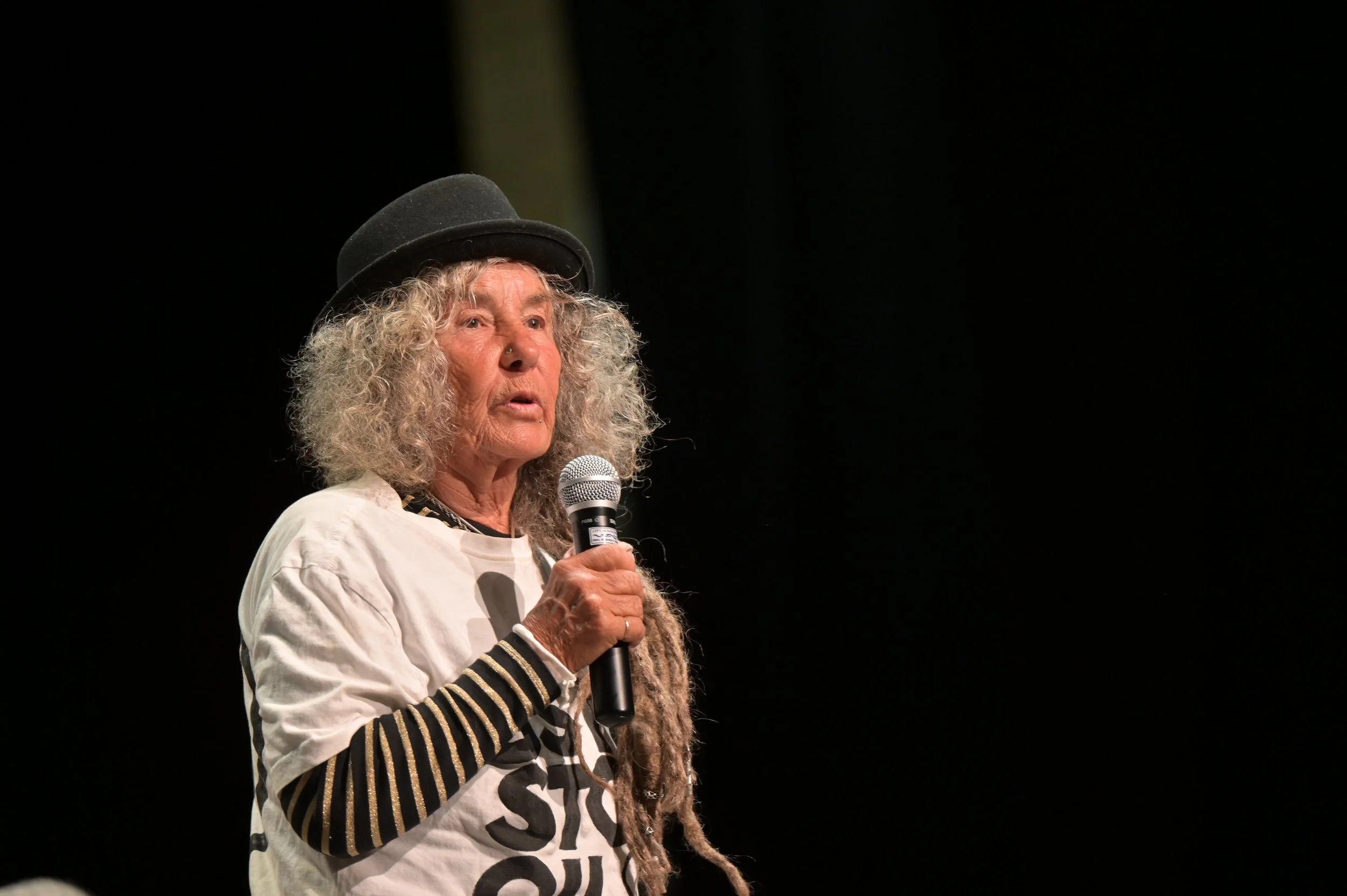
Brunie Brunie has been running for in local elections for the City of Nanaimo for at least 20 years. (Mick Sweetman / The Discourse)
Brunie Brunie: Hi everybody, this is Brunie checking in. I'm the Energizer Bunny that's been running and running, and hey, it keeps my mind sharp and my body in shape! I don't have any political experience, but you know what? Running in elections for twenty years, I've really learned a lot about politics and, for some, a candidate that's had thirty years political experience.
So what has actually been shown to people? There is no affordable housing, and affordable housing is just a word blowing in the breeze. Why? Because of the big profit in the land, the big profit in the land, and the only way we're going to have affordable housing is to totally change our scheme of building.
And food prices. Food prices have gone up like you wouldn't believe. They've practically doubled. So tell me, how has all this political experience actually helped the people of the city? and climate change. Oh, you've all heard about climate change. Hey, that's just a word. That's just a word. Now, and although I don't have a big em-na thing behind my name, I am a logitarian, and all things relate to the basic logic.
And you don't have to be a scientist to keep digging out the oil in the earth on and on by the billions and zillions and trillions. That's where the big money is, fossil fuels, natural gas. And don't you think the Earth is going to be unhappy about that? The Earth is very unhappy about that, and that's what climate change is all about.
We're living on a fault line already here on Vancouver Island, and it won't take very much to bang. We'll lose all our hydro, and then where will you be in all your big houses? There won't be a ferry getting any more food. We're an island, and we must work towards food self-sufficiency, and that is the most important development that I could bring out to you.
Do you see any rooftop gardens on [sic] Nanaimo? Rooftop gardens are in Vancouver. They're down east. They're in many European cities, and not a single one here. Nanaimo is very far behind green ecology. I would have roof top gardens on every housing development and invest in high-tech solar greenhouses throughout the community. Do you wanna buy lettuce for $4.99 from Trumpsville? My goodness, and high food costs and tariffs. We can grow all that right here!
Pugh: Brunie, what do you feel like are some of the, the ways that you could work with Nanaimo City Council, if elected, to try and achieve some of the, the policy outlines, the policy aims you're, talking about there, things like rooftop gardens, things like, local produce?
Brunie: I'd probably have to fight with the city manager because he's the one that does all the development. You must realize that everything that happens in the city is controlled by the city manager and his staff, and I heard they wanna increase the staff. We don't need to increase the staff. Economy is not booming, and the lower we can keep taxes, the better!
Personally, I would be happy to take a tax cut in the [mayor] salary, and I'd like to see more. The thing is, let's say I'm mayor. Hey, does that make me the smartest person in the city? I don't think so. I care a lot, but we're all smart. I would have public meet— debate meetings at least twice a year where people can come in and speak their concerns, and together, together as a community, we could come to the best solutions that could happen.
Pugh: So I'm hearing from you there you're in favor of, reducing or at least not expanding the size of staff … that you're also in favor of having public town halls a couple of times a years—
Brunie: —Yes.
Pugh: —on major issues. Is there anything else you'd like to highlight for people as part of your agenda?
Brunie: Well, the taxes. I would have a really really good look at all the taxes and expenditures. I don't believe we need a city works yard. We don't need to change the flowers downtown, five times a year. There's lots of things we can cut taxes on.
Pugh: What do you feel like are some of the most important issues that are going to decide this election?
Brunie: People are really worried about homelessness. Now, in cities [sic] like the United States, it is unbelievable. There are thousands and thousands of people in Los Angeles. Why? Because we're going down. We have way too many people. The jobs aren't there. What are we going to do with all these people?
That's why I just continue to say, grow food, grow food, grow food! And my answer to home— homelessness is not going away. Now, President Trump is rounding up the people in his country and putting them in concentration camps. Wow. And you think everybody on the street is addicted? Now, here's the thing about addiction.
Now, I know a lot of people are addicted, and the reason a lot of them are addicted is because they have lost hope. They have lost the hope of having any kind of a decent human existence. So they take these people, they go voluntarily, and they put them in centres where they're going to un-addict them, okay?
Now, a lot of those centres, there's a lot of people working there. They all have homes. They have good-paying jobs and wear good clothes, but they take these people, and they give them drugs to take them off their addiction. Now, that sounds all really good and everything else. But then, then they take the people, and they put them back on the street.
Now, once they've taken them off these illegal drugs and put them on legal drugs, their system cannot take any more. So there they are, back on the street, stressed out, cold and wet and hungry. So they get right back to taking drugs. But because of this procedure, they are now immune to the street drugs, and they die.
Pugh: Do you think that's happening in quite the way you described it there? So certainly, I think what you're referring to is, if folks do enter some kind of treatment program for addiction, and then they finish it, they might have a reduced tolerance to using substances again—
Brunie: —Oh, they have definitely reduced tolerance.
Pugh: —and, then would make them more susceptible to an overdose—
Brunie: Well they die—
Pugh: —and death?
Brunie: —they die.
Pugh: Yeah, but do you think it's true that there are people being rounded up into treatment centres? I'm on the understanding that treatment is very hard to access right now if you want it, and is the kind of thing you have to pay tens of thousands of dollars for to access privately.
Brunie: The pharmaceutical industry is one of the biggest money-making industry that there is. Now, they have to test these drugs on someone, and I believe they are testing them on homeless people. They have to test them on someone. And then after they send them back out and they die, well so what?
Do they really care? My answer to the homeless situation is that, first of all, shelter is a human right. Let me repeat that. Shelter is a human right! No matter if these people are addicted or non-addicted, they have a right to be somewhere! This is all unconceded [sic] land. That means it was never given. It was never won in war. It was just taken.
There are many areas in the city where we could establish a facilitated campsite. I believe I could get army tents from the federal government, because of course they're responsible too. Have, have it look orderly and clean and not a bunch of tacky tents! And you worry about the garbage you see all over! Well hey, if you didn't have garbage pickup, I wonder what your environment would look like!
We could have a cook tent. People could be warm and clean, and from there, the social workers could come in and help the people in need. And also, there's— a lot of these people would love to have jobs. I believe I could hire some of these people to clean up the city, to clean up all the cigarette butts I find all over the ground.
Pugh: So it sounds like you're describing there that, one of your pitches to address the situation would be to have city-run encampments for people to live in?
Brunie Brunie: Yes, absolutely! Because every day, the people are moved from place to place. They are cold and wet and suffering!
Some people lived under the bridge, so the city put rocks under the bridge. They couldn't live there. Some people lived on the other side of the bridge, so they cut the trees down so that they would be more visible. Every little corner of the city where people hide has been gated. Is this the answer you want?
Is this humane? And all you Christians out there, these are your brothers and sisters. So if they're not going to go away, why not have a campsite where people are safe, clean, orderly, and the city could do something that they could be truly proud of, and they wouldn't be lying around on the streets downtown! Because it's not fair for the businesses to have people lying down the streets downtown.
There's only one toilet and one little dribble of water in the whole city! Come on! We can do better than that!
Pugh: What is your view on how Nanaimo should develop, in the coming years and decades? Right now, the city's official community plan is focused on developing these kind of complete communities around these larger urban centres, places like the Woodgrove area, places like Country Club. What's your view on how Nanaimo should develop as it grows over the years?
Brunie: Maybe it's time to just hold off a little bit on development. Do we have the infrastructure? Do we have the water? We just need to slow down. I have thought hard and fast on affordable housing, because until the profit is removed, there will be no affordable housing, and that's really important. Because there is young people, there are seniors, there are veterans that are living on the street, and that must not go on!
We could build smaller units starting from the bottom. No cars, just scooters and bicycles. The cars have arcades [sic] to live in, but people live on the street. And have smaller units with rooftop gardens that would make these a happy space!
Joe Pugh: What's your view on how the city could play a role in creating some of that affordable housing you described that you'd like to see?
Brunie: First of all, the city can— I would talk to all the builders, and before we build any more high profit developments, that's what we need to address first. And everybody doesn't need to have a shower every day, everybody doesn't need to have their own laundry. We can do— We can have safe, happy places.
People can have jobs growing food. And that's what we have to look at.
We have to look at looking after the people that we got before we go on and on. And some of development I'm not really happy about. Some of the new developments, they look nice and everything, but they've removed the green grass! Green grass is being removed all over the place. Instead, there's rocks, just rocks and pavement!
Pugh: There's a lot more to get into, but we are out of time. Brunie Brunie thank you very much for coming down to CHLY.
Brunie Brunie: Okay. Thank you very much for listening!
Pugh: Brunie is one of four candidates seeking to be mayor of Nanaimo in the upcoming local election. Local election day is October 17th. Advance voting days are October 7th and 14th.
—
That's our show for the day. Thank you for joining me. I'm Joe Pugh, host and producer of Midcoast Morning. Jesse Woodward is our executive producer, and Arbie is our technical advisor. Our theme song is First One by local Nanaimo band Waste Management.
If you have a story you want us to cover, get in touch at news@chly.ca. You can also subscribe to our email newsletter at chly.ca/subscribe. That's all for now. I'll talk to you on another Midcoast Morning.
—
Announcer: This program gives thanks to the Snuneymuxw First Nation as we broadcast and podcast from their traditional territory. Thanks for listening.
—Transcript End—
Report transcription errors by emailing production@chly.ca.
Program Notes
Guests
Anne Marie Dryden — Retired financial advisor, and REAL candidate for mayor in the City of Nanaimo.
Brunie Brunie — Perennial candidate for mayor and council for the City of Nanaimo.
Program Team
Joe Pugh — Host and Producer.
Jesse Woodward — Executive Producer.
Arbie Fru — Technical Assistance.
Podcast Photo
Mayoral candidates for the City of Nanaimo, Brunie Brunie and Anne Marie Dryden and (Mick Sweetman and Jesse Woodward / CHLY 101.7FM)
Theme Music
Funding
This program is part of our Nonprofit Newsroom Project. Sustain local news for many years to come by signing up for a monthly Sustaining Donation.