
City of Nanaimo Mayoral candidates Sarah Lovegrove and incumbant Leonard Krog
Synopsis
Ahead of the October 17th local elections in British Columbia, Midcoast Morning spoke with each of the four candidates running for Mayor of Nanaimo. In this episode, VIU nursing instructor Sarah Lovegrove and incumbent mayor Leonard Krog.
Transcript
Editor's Note: This transcript has been lightly edited for style, ie: filler words, stutter-starts, and repeated words have been removed.
—Transcript Start—
Announcer: The following is a project of our nonprofit newsroom. Support Midcoast Morning and local journalism today at chly.ca/donate. Local news doesn't survive without local support
—
Joe Pugh: Welcome to Midcoast Morning. I'm Joe Pugh. Today on the program, we bring you interviews with two of the four candidates seeking to be mayor of Nanaimo. We'll hear from VIU nursing instructor Sarah Lovegrove and incumbent mayor Leonard Krog.
—
Pugh: I am joined now in the CHLY studio by one of four contenders to be the next mayor of Nanaimo, Sarah Lovegrove. Thank you for coming down. What made you throw your hat into the ring?
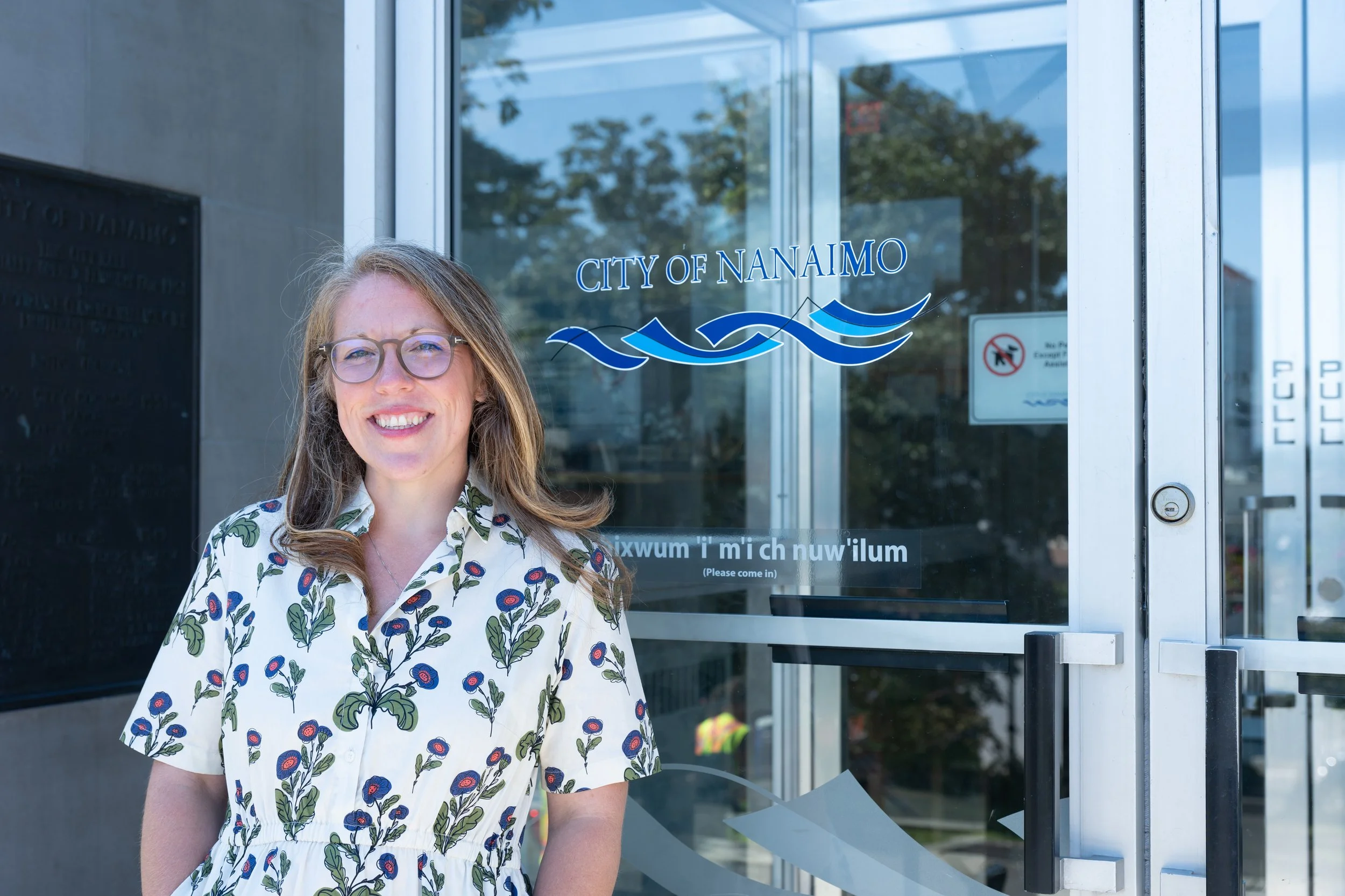
Sarah Lovegrove on the day of her announcement that she intended to run for mayor. (Jesse Woodward / CHLY 101.7FM)
Sarah Lovegrove: Thanks for having me, Joe. So I am very interested in creating a community for us that is led by compassion, and is led by evidence, and is led by humanity, and centres humanity in everything that we decide. And I feel like there's a tremendous amount of opportunity in our community to create that, and I think I'm the best person to do that job.
Pugh: So let's talk maybe about how you see the role of Nanaimo City Council with you as the hypothetical mayor, in achieving that.
Lovegrove: Yeah. So in terms of Nanaimo City Council, I recognize that the mayor is one of nine votes, but in that process, there is collaborative leadership, there is open and honest debate and discussion, and there is the ways in which our city is represented on a provincial, national, and international stage.
And I feel as though we haven't had the opportunity to shine in the last eight years as a result of the leadership that we've been provided with. So I think there is a real space to improve, to refocus, and to find solutions to the really complex challenges that our community's facing.
Pugh: What do you think are the most important or significant issues that Nanaimo is facing that you would like to address in some way on city council as mayor?
Lovegrove: Yeah. In the last eight years and the last month and a half of talking to people in our community about the issues that are important to them, I'm hearing across the board that housing, homelessness, the toxic drug crisis, and what we're seeing on our streets is the primary concern of our community.
And I have to agree. That's the work that I've been doing in community advocacy for the past eight years, and it's really important to me that we address that and not just shirk that responsibility off to other levels of government.
Pugh: What do you see as the way to address that?
Lovegrove: So in terms of housing specifically, I think we have a lot of opportunities.
So advocacy is one that is being put forward all the time by the existing mayor and council, but I think the voice of advocacy that comes to this challenge has to be informed, and it has to be centred in compassionate evidence that is actually listening to the ways that experts are telling us to move forward.
And right now, that's coming from a lens of stigma and- lack of responsibility. But I think with my expertise and my connections to policy experts and people across the country who are doing this work, including the Federal Housing Advocate, we can actually find solutions that are meaningful, and I know how to ask for what we need in our community in a way that we will get us the money and get us the resources that we need for housing.
I also see a lot of opportunity within the toolkit that we have with City Hall, so pre-zoning, leveraging, permitting, and developing, and moving these housing projects forward. There's a huge difference between underway and open and lived in, and so I want to make sure that the housing we get and the housing that we've already acquired is moved forward to the point where we can actually get people under roofs.
Pugh: In terms of decision points on housing or supportive housing or homelessness in the previous council term, some that come to mind are the Hub, a drop-in shelter that was on Nicol St. Also we've had the recently announced that they will change a model to sober housing, supportive housing, on Terminal and Bryden.
Is there anything that you would like to comment on those issues or how you would navigate something like the Hub drop-in service?
Lovegrove: Yeah. So when the Hub was opened, it was— I don't think anyone in our community that was a good place. That was not a good location for a service that specifically catered to people who are unhoused, and we need to find a better one.
So I understand the reasons why it shut down. However, in this community right now, we have zero open doors during the day for people who are in need. Right now, people's only opportunity for support, sheltering, [and] hiding from the elements is going to our public libraries and the lobbies of our city-owned facilities.
So we're actually increasing the burden on those spaces by not having a hub or some sort of centre open for people who are unhoused. So a priority moving into this role will be finding a location immediately that suits both neighborhood needs and the needs of their people who are most marginalized in our community.
In terms of the new, recovery-oriented housing on Terminal, I am absolutely for any kind of permanent housing going up. I celebrate the decision. I am hesitant to, throw my full, board of hope into it because I'm not trusting how it's being rolled out. I am hearing from social workers on the front line that they are already decanting and not, putting people back into the empty spaces, even though construction isn't set to start until January.
We have a lot of cold days ahead of us, and I think keeping a space open that someone could be housed in is problematic. And I also think that, we don't have enough treatment opportunities on the island and in BC specifically to be actually able to put enough people who are in a recovery-oriented situation into that housing.
I also think that with that decision-making model and putting the onus of structure and programming on an operator that we have yet to identify is potential for problem because when people-- we know from a medical lens that In the process of recovery, relapse and reintroduction to a relationship with substances is an anticipated point of that medical recovery continuum.
And so what are we, doing with it, a recovery-oriented dry housing model, if people are expected to relapse? If they start using again once, or if they re- reengage in a relationship with substances, are they gonna be unhoused again? I don't know. We don't have an answer to that, and city council currently cannot answer that question.
So I am curious, I am cautious, and I am awaiting to see how it rolls out.
Pugh: As a mayor or a city councilor, one thing you spend a lot of time doing during meetings is hearing applications for rezoning. I'm wondering, how you see Nanaimo developing over the next few years, what you feel the best way is for Nanaimo develop, to develop over the next decade, and how that kind of philosophy would shape your decision-making on some kind of, some of the rezoning applications you might face as Nanaimo continues to grow.
Lovegrove: Yeah. I think there's a lot of space in Nanaimo to develop on land that is unused. We have a lot of space, downtown in our ind- industrial areas that can be redeveloped and rezoned, to increase our industrial tax base. I think there's a lot of space available, and I think that these decisions need to come with a balanced approach and with a sustainability mindset, where we need to be cautious of destroying environmental ecosystems, gems in our community like Cable Bay.
We need to be looking at, environmental impact reports. We need to be listening to our community members like the Rock City Wetland folks, and making sure that we are balancing our environmental preservation and protection with our need for industrial growth we have a lot of people coming in with incredible environmental knowledge in, on the ballot box right now, and we should be listening to those people.
We should be resisting the, the urge to sprawl industrially. We can build up, we can increase density, and we can offer opportunities within the existing boundaries of what we've created already.
Pugh: there's one issue you touched on there, potential redevelopment of some lands next to the Cable Bay Trail that seems like it's one that's probably gonna be an issue for the next council to decide on. So the property owner, Harmac, has been looking to rezone some lands just to the west of the trail. it faced a, a public hearing. A lot of people came out. The public hearing had multiple sessions, and in the end the question was referred back to staff, to chat with the proponent about a couple of different points. How do you... Is there anything you would like to let people know about how you might handle that issue if it were to come back?
Lovegrove: Yeah. I think I am just, I'm in awe of the public hearing process. I think it was incredible to witness the passion of our community and the ways in which our community members stood up for the environment.
It's a beautiful thing to witness. I am a regular user of the Cable Bay Trail. I take my dog on a walk there several times a month. I have seen orcas. I have seen beautiful, wildlife and precious ecosystems there for the last eight years, and I'm pr- I would love to preserve it for future generations.
I think it is an absolute gem in our community, and I think we need to be listening to the community members that have clearly spoken as to what they value. I also really hear in this public hearing process the desire to slow down and listen to Snuneymuxw First Nation. they need to be a part, a, an essential piece, and their voice needs to be heard in this consultation process, and I look forward to hearing that moving forward.
Pugh: How would you try and manage infrastructure needs that Nanaimo is facing, with the cost of those infrastructure needs if you were mayor?
Lovegrove: Yeah. I think that's a really important question. We have a dire need to improve our infrastructure. We- our infrastructure is aging, and it is in need of improvement.
I think what we need to be focusing on is saving the money that taxpayers are giving us now. Currently, I believe we are spending a lot of money on downstream interventions for the challenges that we talked about earlier on our streets that is costing the taxpayers a significant amount of money. they are paying more so in costs for justice and enforcement.
They are paying for emergency calls and hospital visits that are preventable by upstream solutions. So if we invest now in upstream solutions like supportive housing and actually creating spaces for people to go instead of moving them around, we can actually save money that we can reinvest into the essential infrastructure that our community needs.
Pugh: How do you view, how you'll approach the issue of potential property and ta- property tax increases? That's one that seems to generate a lot of commentary online. they seem to go up by a few hundred dollars every year, and it's always pitched as, a couple hundred dollars every year.
But, after several years, that starts to add up.
Lovegrove: Yeah. I feel the pinch of the affordability crisis along with everyone else. This is something that is touching every single person in our community, and it is deeply noticeable. And as a renter and as someone who is on a limited income myself, it's really something that I'm seeing as a priority across all socioeconomic statuses in our community.
And it's actually not my intention to highly, increase our property taxes. I think we have a lot of opportunity with our existing budget. I think we can manage it better by looking at our budget through the lens of measurable outcomes and actual results, where we can renegotiate some of the way that we are currently spending to mitigate some of the impacts on the taxpayer
Pugh: We just have a few seconds left. Is there anything else you think it's important to maybe highlight about what you feel this campaign needs to be decided based on?
Lovegrove: I think this campaign needs to be decided on what our future generations are asking for. Right now, I have the real privilege of working with young people in our community and listening to young people, and there is real fear and real anxiety about how we're moving forward in our community, both environmentally, socially, and the way that which we're…
[pause]
… the ways in which we're providing services and supports for the people who are most marginalized. And we're not creating a community for the past. We're creating a community for the future, and I would like to build one with the people who are gonna grow up in this community in mind.
Pugh: Sarah Lovegrove, thank you very much for coming to CHLY.
Lovegrove: Thank you so much, Joe.
Pugh: Sarah Lovegrove is running to be mayor of Nanaimo. Coming up, we'll hear from incumbent mayor Leonard Krog.
—
Announcer: Midcoast Morning is part of our nonprofit newsroom project supported by listeners like you. Keep this program on the air by funding it today with a monthly sustaining donation at chly.ca/donate. We've got tote bags and shirts if you need an incentive.
—
Joe Pugh: Today on the program, we're hearing from two candidates seeking to be mayor of Nanaimo. I am joined in the studio by Leonard Krog, one of four candidates to be Nanaimo's next mayor. Nanaimo's current mayor, what's prompted you to throw your hat in the ring for a third term?

Leonard Krog at his official campaign launch for his third term as mayor of the City of Nanaimo. (Jesse Woodward / CHLY 101.7FM)
Leonard Krog: Two things. I really enjoy being mayor. it's very rewarding. You learn something every day. I work with good people. but the second thing is there are a number of projects underway, and things that I'd like to see underway, that require finishing and guidance and I want to drive that agenda.
Pugh: What do you see as the major issues facing Nanaimo over the next four years?
Krog: The major issues often revolve around things that we can't fix, unfortunately, and most particularly is the street disorder, the mental health addictions trauma and brain injury crisis, and the homelessness and petty crime that follows from it.
For that, we require significant intervention by the province and the federal government, and we're starting to see movement in that area. But, on the practical side, the things that the city has control over, if you will, we need a South End Community Centre. We need a new public works yard. We need an RCMP station.
The demands for our parks and recreation are increasing, not reducing. Our population is still growing. It has slowed, but it is still significant compared to other communities. And so the demands for municipal services continue, and moreover, we have to ensure that we maintain a continuing program that allows us to deliver water, sewer, [and] garbage. In other words, the hard assets, if you will. Asset management is a really important aspect of what we do in the city
Pugh: Well, on that issue you identified off the top there. If I'm thinking of some things the city has done more actively to address pieces of the puzzle, I can think of The Hub on Nicol St., a temporary drop-in shelter.
I can think of advocacy that a supportive housing site coming to Terminal and Bryden follow a recovery-oriented or dry model. I can also think of, say, community safety officers. What would you say, in terms of your rationale, your decision-making on the things the city has decided to do.
Krog: Look, around the Hub right off the bat, I think those kinds of facilities are definitely needed when we have such a significant portion of our population who are unhoused and have no shelters at night.
Nanaimo, unlike the City of Vancouver, where they have shelter beds for 80% of their street population who are, in fact, without any housing, ours is less than 20%. The location and the management of it, and most particularly the management of the behaviours around them are the problem. The Hub where it was centred in one of the most welcoming, and caring parts of our community, the South End, proved to be such a disaster for the locals in terms of criminal behaviour, public behaviours that were very disturbing, that the city elected not to continue to fund it.
It doesn't mean the need isn't there, sadly, and I wish I could offer some quick answer. Around the whole advocacy piece, look, we have advocated long and hard in the city for the full continuum of care that's needed to deal with our street disorder. And in that sense, you've already mentioned it, we have been successful, particularly around the Bryden or 250 Terminal site, which will be a substance-free housing.
And that was, the hard work of the local Newcastle residents, and as their association, pushing for that, and that was a major victory, because the province and we had the letters from the minister saying, “No, we're not prepared to do this.” The government changed their mind, and I think that's crucial.
The other thing, that, in terms of advocacy, I have advocated for a long time for secure involuntary care, or what Mayor Dyas in Kelowna refers to as compulsory compassionate care for the severe cases. I find it almost appalling that there are segments of our community who will refuse to accept that there are individuals on our street who are living lives of complete and utter misery, and are not going to get any better as long as they're left in the streets to literally, in some cases, die.
And that's an important part of the solution. It will take pressure off our first responders, including firefighters, paramedics, [and] our community safety officers. The team of 22 folks are out there all the time, doing the best they can.
[pause]
But it's only a small portion of the population. The whole bunch more need supportive housing, and some are just plainly poor. They simply cannot afford the private sector costs of accommodation, and the government has not built enough public accommodation. Now, you can use various terms, subsidized, supportive, whatever you want to talk about. We are dealing with 30, 40 years of failed social and health policy.
Most European countries, it's something in the range of 20 to 30% —don't quote me, I'm not an expert, all right—in terms of building what we used to refer to as public housing. In this country now, we're clocking in, one of my real estate friends who's very attuned and a thoughtful fellow tells me the last figures they heard was something in the order of 4 per cent.
That is a huge gap.
Pugh: What, if anything, do you feel like it is the municipality's role to do in that context? I know in the spring and summer, Nanaimo City Council was flirting with this idea of giving some funds to a potential Nanaimo housing pilot. Dale Lindsey, the CAO, has mentioned, you could consider a municipal housing authority.
Are those things you think would be a good idea for the city to do?
Krog: The concept is very appealing, but it has historically worked where cities have a lot of land. We don't. In the meantime, what we have done is we've provided land to the provincial government, BC Housing, and Cornerstone is a prime and most recent example.
Right across from the RCMP station, the Cornerstone facility is on municipal Nanaimo city land. and there's an example of where we've provided land. We've provided [it] in other places as well. So we have cooperated as best we can, keeping in mind, and I don't wish this to sound harsh, but it is not municipal government's responsibility, nor do we have the jurisdiction, we certainly don't have the resources, to deliver housing any more than we should be delivering healthcare or mental health and addiction services. That is not what municipalities are designed for, that is not what the legislation requires us to do.
But you know what? I appreciate that you can run into me in the grocery store and on the streets, every day, and obviously it's municipal politicians who hear it the most. and it's frustrating because it has a significant negative impact in our community. I've said over and over again to remind folks, because people are losing compassion to some extent, every time you run across someone in the street who looks like they're living a life of misery, don't forget it's somebody's family member.
Pugh: Well, one thing that certainly municipal politicians do control is, zoning, land use, and shaping the growth of the city, dealing with rezoning hearings. What is your view on how Nanaimo should grow and develop over the next decade or so?
Krog: Look, nothing's changed. I understand one of the candidates the other day at an all-candidates meeting that I wasn't at. It was for a smaller group, an invited session, said, “Oh, we don't want, it, densification or industry inside the city. We want it outside the city limits in the country.”
Look, I've said over and over again, we are either going up as a city or we are spreading into the regional district. I do not believe in urban sprawl. I support, having, densification as... And the best example most recently are the two buildings that—apartment buildings—that have gone up on Wallace St.
That's what it's all about. But encouraging and dealing with that is not going to solve the problem per se of people who simply can't afford the private marketplace. It helps to this extent that we go through boom and bust cycles, and so if the private sector overbuilds, rents stabilize and then they eventually start to decrease.
Housing costs start to decrease. But those are, how shall I say, longer term solutions, and they will provide relief at some point down the road, but not immediately today. We have housing needs today, we have a significant unhoused population. We have a significant portion of that unhoused population simply, as I say, can't afford the private marketplace, and so unless the government steps in, we're out of luck.
And interestingly, Nanaimo is meeting all the housing targets set by the province except in the area of what we'll call, housing for those who can't afford the market.
Pugh: Over the last year or so, there have been a number of issues that attracted significant public interest in council meetings, rezoning, hearings around issues of development and tension with the environment. You could think of the lands near Cable Bay. You could think of the Rock City wetlands. Is there anything you would like to let people know about your view on these issues?
Krog: Look, and I can't comment specifically, nor will I, on proposals that are before council that involve public hearings.
I'll put it as simply as that. But I will say this. We need an expanded industrial tax base in this city, and that means that there will have to be rezonings in due course of appropriate lands. Nothing's going to be perfect, but we need the jobs. Moreover, we need the tax base.
The people in the city, whether they're renting or own, are all paying property taxes. All right? That's the first, and if you don't have industrial or commercial lands to pay a share of the property tax, then it's going to come off residential property, owners or renters. So it's really important not just from the point of view of the jobs and providing employment for our citizens, but it's important, from the point of view of trying to keep taxes within a reasonable range as we see an increasing population.
Look, people have discovered us. The east coast of Vancouver Island is the most moderate climate in the British Commonwealth. Everybody wants to live here. Talk to anybody who's moved here in the last four or five years.
Pugh: Is there anything you would say to people who are concerned about increases in property tax over the last number of years about how you view trying to stick handle that in the coming term if reelected?
Krog: Look, as I've said, we need industrial land to balance that off. In terms of increases, contrary to popular belief, we don't throw money away willy-nilly, and I, as I remind people, particularly with respect to the consumer price index, which people often say, “just increase my taxes [the] same as the consumer price index.”
I've said it over and over again. We don't buy a lot of groceries and toasters at City Hall, but we do buy a lot of steel and concrete directly and indirectly, when we hire and let out contracts for the construction of roads, sewer, water lines, et cetera. Those costs are way higher than the consumer price index.
That is a reality, and we have no choice. I can't say to somebody on the street, “I'm sorry, we're not gonna replace the sewer line that's leaking. We're not gonna replace the water line that's leaking. we're not gonna pave your road, that's filled with potholes even though it's damaging your car because we don't want to increase your taxes.”
We deliver the most basic of services for people. We deliver the water, the sewer, [and] the garbage. We maintain the streets, we provide the parks and recreation for our citizens. You can't just— people talk about efficiencies—trust me, if there were efficiencies, believe me, as politicians currently in office, taking both the compliments and the criticism, we'd be doing it!
Pugh: There are just a few seconds left. I'm just wondering if there's anything else you think it's important to highlight for people about what you feel this campaign should be decided based on.
Krog: Look, for the mayor's race, I say quite simply, if this— you think of this as a hiring process, and it is, compare the resumes of myself and the other candidates. Look not simply at what is on that resume in terms of community service, experience, education, knowledge, and skills. Look at what's not on the resume.
Pugh: Leonard Krog , thank you very much for coming down to CHLY.
Krog: Thank you.
Pugh: Incumbent Leonard Krog is one of four candidates running to be mayor of Nanaimo. Look for our program featuring interviews with the other candidates in the race to be mayor on our website, chly.ca/midcoastmorning. Election day is October 17th. Advance voting days in Nanaimo are October 7th and 14th.
—
That's our show for the day. Thank you for joining me. I'm Joe Pugh, host and producer of Midcoast Morning. Jesse Woodward is our executive producer. Arbie Fru, our technical advisor. The theme song is First One by local Nanaimo band Waste Management, and you can get in touch with us at news@chly.ca. That's all for now. Talk to you on another Midcoast Morning.
—
Announcer: This program gives thanks to the Snuneymuxw First Nation as we broadcast and podcast from their traditional territory. Thanks for listening.
—Transcript End—
Report transcription errors by emailing production@chly.ca.
Program Notes
Guests
Leonard Krog — Incumbent mayor of the City of Nanaimo.
Sarah Lovegrove — Candidate for mayor of the City of Nanaimo.
Program Team
Joe Pugh — Host and Producer.
Jesse Woodward — Executive Producer.
Arbie Fru — Technical Assistance.
Podcast Photo
Incumbent Mayor Leonard Krog at his campaign launch. Candidate Sarah Lovegrove on the day of her announcement (Jesse Woodward / CHLY 101.7FM)
Theme Music
Funding
This program is part of our Nonprofit Newsroom Project. Sustain local news for many years to come by signing up for a monthly Sustaining Donation.