
With a boom in clean energy, a new art exhibit at the Nanaimo Art Gallery, looks at the true cost of it all
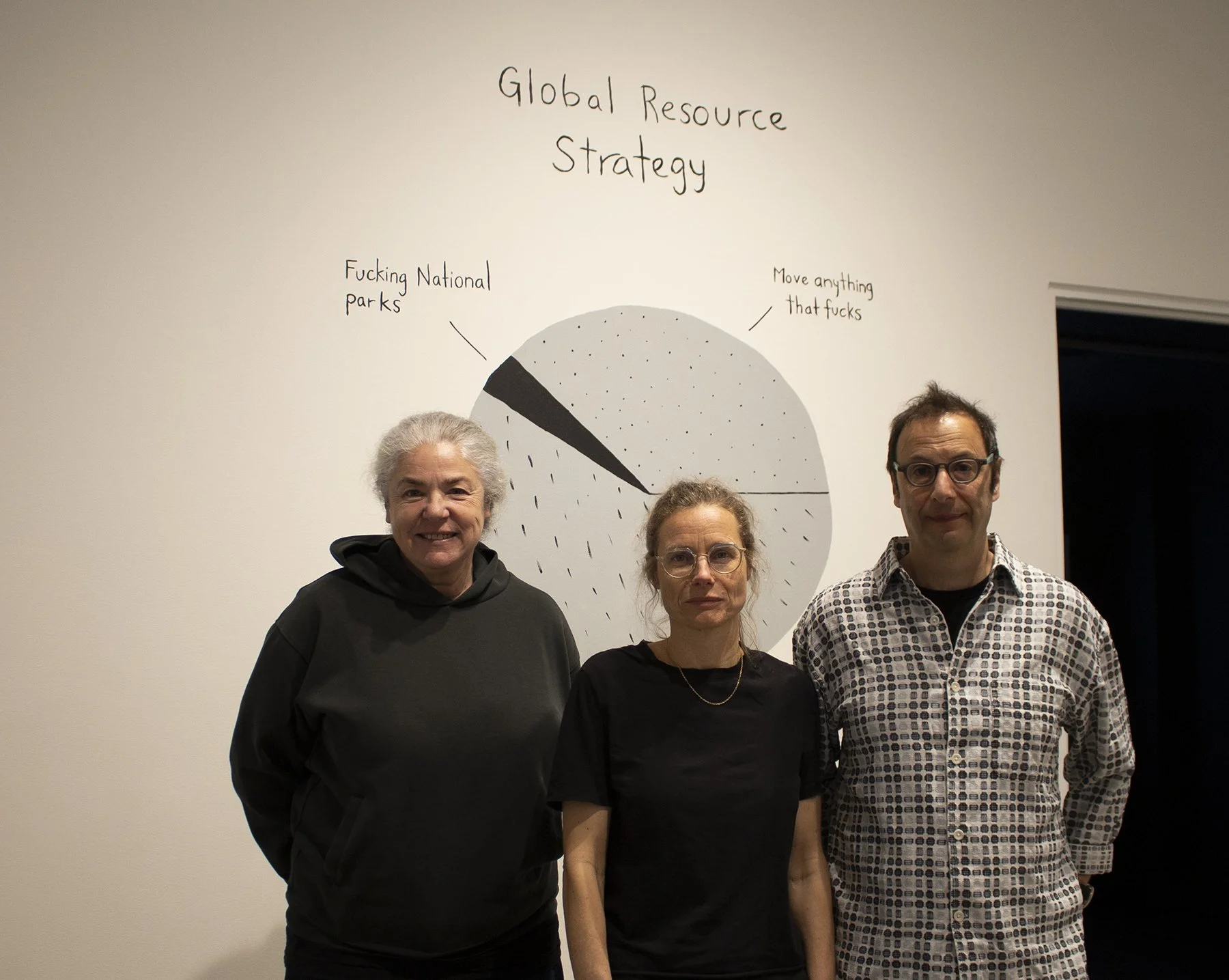
During their time in Argentina the trio investigated lithium mining throughout the country and the devastating impacts mining has had on the environment. (Lauryn Mackenzie / CHLY 101.7fm)
While countries around the world work to switch from fossil fuels to green renewables, a new exhibit takes a step back and gives voice to those affected and affecting the clean energy transition.
In An Animated Assembly, the newest exhibit at the Nanaimo Art Gallery, Canadian artist duo Richard Ibghy and Marilou Lemmens examine the global boom in clean energy and the effects it has with resource extractive activities in many parts of the world.
Told through hand-painted murals, short animations, and sculptural works, the exhibit shares the viewpoints of both humans and nature as the world goes through a clean energy transition.
The exhibit is curated by Sylvie Fortin. She, Ibghy and Lemmens met with CHLY ahead of the exhibit opening.
Fortin said the trio started working on the exhibit in 2019, but many pieces of it came following a research trip to Argentina.
“So we worked in Argentina for a while doing research and presenting an exhibition. We also came here last summer, to Vancouver Island to continue to think and see those questions and those realities from a very different perspective,” Fortin said. “I think the show is about; that it's about always thinking of a place in its relationship to a kind of global flow.”
During their time in Argentina the trio investigated lithium mining throughout the country and the devastating impacts mining has had on the environment.
Lithium is a rare earth metal and a key ingredient in rechargeable batteries that is commonly used for electric vehicles.
A study published by the Royal Society, noted mining and extraction of lithium in countries such as Argentina have been linked to water scarcity impacting native ecosystems, and birds like flamingos.
Lemmens said during their trip they visited western Argentina and the north of the country where the country borders Bolivia and Chile. This region of South America is commonly known as the ‘lithium triangle’ and 75 per cent of the world’s lithium is produced between Bolivia, Chile, and Argentina.
“There we were interested in meeting people from communities who had been resisting multinationals that were coming to mine in their region,” Lemmens said. “So this is a very special place, because for over 20 years, they've been resisting successful mega mining, including Canadian companies who went there to extract gold.”
According to Natural Resources Canada in 2024, Argentina was the fifth biggest producer of lithium worldwide, ranking behind Zimbabwe, China, Chile, and Australia. Chile and Argentina rank first and third in world reserves of the rare earth mineral.
“It's a mineral component that's in our computers, in our phones, but also very present in the batteries for electric cars,” Lemmens said. “We met with local communities, including Indigenous leaders, to see how lithium was affecting people who have been living in these very fragile ecosystems for a long time.”
This exhibit comes during a global “clean energy transition” where there has been an international shift away from fossil fuels to renewable energy sources like wind, and solar.
Ibghy said when Fortin first invited the two of them to visit Argentina, he said at first he didn’t understand what “two Canadian artists possibly have to say to a population that has been through so much and experienced so much difficulties.”
“A lot of the mining companies that operate in Argentina are Canadian, so we have that link. At the same time, there was a strong push, especially in Quebec, but in other parts of Canada for a transition from fossil fuels to greener forms of energy,” Ibghy said. “So while people in the north we felt were feeling good about undergoing an energy transition from fossil fuels, we realised that that desire had a very strong impact, both materially, environmentally and socially, on the people of the Global South; that while we were patting our backs for driving electric cars and feeling that we're saving the environment, we were displacing whole populations.”
Ibghy said this exhibit looks at the complexities of the transition, what while it’s good to move away from fossil fuels, there is a price to be paid in that effort
Another aspect the exhibit examines is consumerism. Fortin had this to said:
“We rarely talk about that, because often when we think of consumption, a lot of people think that if you consume less, then you have a poor life,” Fortin said. “I think that there's a lot of work to be done at that level, that consumption is not always joyful and pleasurable, and that perhaps consuming less can be something that is really amazing and positive.”
Humour is at the forefront of this exhibit. Ibghy said, while using a playful manner to create art was first something to bring people into their exhibits, they discovered through their careers that humour supports how they get their message through to the viewer.
He also said humour has historically been used as a way to undermine power.
“Societies for the longest time have used humour as a way to indirectly contest the powers and the authorities that be. You can be playful and be coy, and it's very hard to kind of pin down,” Ibghy said. “I think that humour is also a way that we try to undermine the authority of such things as graphical forms of representation, diagrams, maps, analytical tools that come from economics or management, that appear so perfect, so authoritative.”
Ibghy said while their work deals with serious issues, they try to present their work in an open manner that showcases different perspectives and points of view to not just represent one subject position but several.
“It's to bring dialogue and to remind ourselves that being political is not so much about voting and representation,” Ibghy said. “Being political means having public discussions regarding public interest, that the decisions of our society should not be dictated by the efficiency graphs presented by economists that's saying that this is the way forward, because this will bring us greater productivity, but that there are many decisions that a society must take based on their values.”
While pieces of the exhibit feature many of the voices they heard in Argentina, the two artists also looked at topics of offshore wind farms, and oyster farming.
This exhibit continues the Nanaimo Art Gallery inquiry for 2026: How can we live together? This is a question Lemmens said they explored while working on this exhibit.
“For us, this is a question of reimagining our society and who's part of this society. Is this just a question of humans? How do we live together includes oysters, wind farms, vicuña, other animals, other beings?” Lemmens said. “It's about really thinking in the 21st Century, what kind of conception of living together do we want to create. How do we want to change from the model of the 20th century, which was all about humans, and I think that's a question that is deep down in all the works that we're showing here.”
An Animated Assembly is now open at the Nanaimo Art Gallery. The exhibit runs downtown Nanaimo until July 12, 2026.
Funding Note: This story was produced with funding support from the Local Journalism Initiative, administered by the Community Radio Fund of Canada.