
All speakers opposed at second night of Cable Bay public hearing
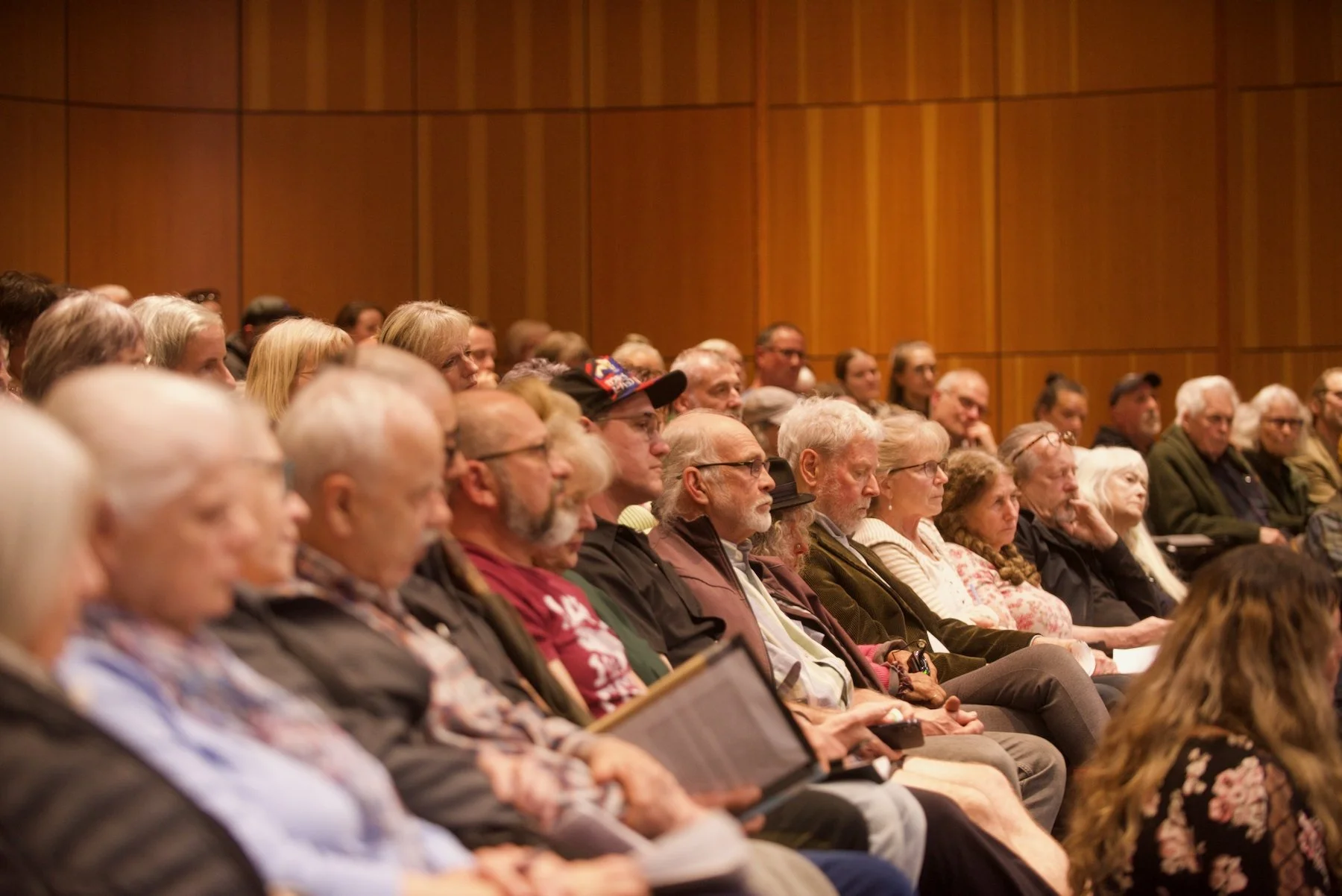
Over 70 people spoke in person or over the phone in the public hearing at the Vancouver Island Conference Centre where two overflow rooms were made available for attendees. (Jesse Woodward / CHLY 101.7fm)
Once again the Shaw Auditorium was packed with concerned locals before city council, voicing their opinions on the proposed rezoning of land near the popular Cable Bay trail.
On Wednesday April 22, the City of Nanaimo continued its public hearing regarding the 75 hectares of land near the southeast edge of Nanaimo. This land would be rezoned from Rural Resource (AR1), to Industrial (I4).
According to the City of Nanaimo I4 zoning can be used for “heavy industrial development that is not compatible with residential uses.” The current zoning of Rural Resource allows for agricultural and rural uses.
The land is owned by Nanaimo Forest Products, also known as Harmac Pacific.
Over 70 people spoke in person or over the phone in the public hearing at the Vancouver Island Conference Centre where two overflow rooms were made available for attendees.
While Nanaimo Forest Products CEO Paul Sadler and some members of the community spoke in favour at the first public hearing on April 16, all 72 speakers at Wednesday's public hearing were opposed to the rezoning.
Members and Elders from the Snuneymuxw First Nation were the first to speak, including Elder Stephen Thomas.
“I'm going to voice my opposition to the rezoning application. I believe proper protocol wasn't followed. The leadership of the Snuneymuxw were excluded from the onset of the rezoning application,” said Thomas. “Talks with Snuneymuxw were needed to begin the process, as federal and provincial legislation require no exclusion of First Nations leadership in regard to their ancestral territory being discussed in talks about future development. Negotiations are now definitely going to be part of a process moving forward.”
He said as a Snuneymuxw Elder, he believes it is their duty to save the area for future generations.
“I hike this area extensively, and the wildlife is in great abundance and easily accessible to see and enjoy. I've personally seen killer whales, sea lions chasing salmon onto the beach, deers on the trail, owls, eagles and blue herons,” Thomas said. “Dodd Narrows is close by, and salmon pass through and it's home to shellfish, crabs, oysters and clams, a staple of ours. Another industrial site would jeopardise this so we must protect the area to the best of our ability.”
Right before the Wednesday public hearing the Snuneymuxw First Nation issued a statement strongly opposing the rezoning application, stating that the lands in question are treaty protected, culturally important, and that the process is moving ahead without Snuneymuxw consent.
In the statement, Chief Mike Wyse, Xum’silum stated that the land represents an “integral part of Snuneymuxw historical village sites, cultivated fields, gathering places, hunting grounds and resource camps protected by the Snuneymuxw Sarlequun Treaty of 1854.”
“I have stood in oil on a marine foreshore in an actual quick deployment emergency. I have been so covered in it myself that I struggled with the reality of bringing that contamination into my family home,” said Roxanne Croxall, a local environmental scientist and consultant. I know what it looks like when intelligent design fails. We can walk away from a spill, go home and wash it off, life in that water cannot.”
She spoke to concerns of what more industry could bring, pointing to the recent January 2026 oil spill that saw a sizeable amount of diesel enter into the Northumberland Channel between Duke Point and Gabriola Island. Harmac itself was not involved.
“I think it is imperative to point out that that spill originated from a diligently engineered licensed disposal facility specifically designed to contain industrial waste,” Croxall said. “Councillors if an intelligently engineered licensed disposal facility cannot contain a spill, and our bureaucratic systems cannot coordinate a response, you cannot guarantee the safety of our shoreline.”
The rezoning would require a 100 meter average buffer between the industrial land and the Cable Bay trail. Croxall said it’s not enough for the endangered species currently living there.
She stressed the importance the Cable Bay trail and surrounding areas have for the community.
“This past weekend, Mr. Mayor, I watched as you stood next to my daughter at the opening of the new recreational E&N trail. You proposed a revision to Robert Frost's “Mending Wall” poem. You spoke of good neighbours making good trails. In the spirit of the actual poem, it is the landscape, not the fence, that connects us,” said Croxall. “Good trails make good neighbours. Cable Bay is that trail.”
Hunter Jarratt, a local ecological restoration consultant and conservationist, said that Cable Bay holds some of the last intact Garry oak ecosystem in the country.
“These are the most biodiverse terrestrial ecosystems in the province. This is a national responsibility,” Jarratt said. “This is the only known location of white-topped aster in the city of Nanaimo, a provincially blue listed species. Slim leaf onion, another blue listed species, is present [in Nanaimo]. Muhlenberg's centaury, a red-listed [rank] S1, meaning critically endangered species, is found in the adjacent property parcel.”
He said if this rezoning is approved, Nanaimo will have nothing left for many of these species.
“So with that, I ask, have you ever seen an island blue butterfly? Have you ever heard a Lewis's woodpecker call in a Gary oak ecosystem, or noticed our Torrey's willowherb in bloom? How about lobb's water-buttercup, or Oregon lupin?” Jarratt said. “I can answer that question for you. You haven't, they're extinct. The habitat in which they needed to survive has been systematically destroyed.”
Also at the public hearing was Regional District of Nanaimo director Jessica Stanley. Stanley oversees the Electoral Area A, which includes the unincorporated community of Cedar, south of the proposed rezoning.
She said she has been hearing a lot from residents in Cedar about the proposed rezoning.
“It is disappointing that the staff report identifies the lands to the south as rural but neglects to identify the property bordering this proposed industrial site as zoned rural residential,” Stanley said. “There are several residents in the near vicinity of these lands who will be significantly affected by the decisions that you make. City of Nanaimo documents state that industrial lands are viewed as not compatible with residential uses.”
Stanley said she confirmed with City of Nanaimo planning staff that there are no required setbacks for industrial land use from adjacent residential properties in Cedar.
She said the proposed industrial use for the area means uses such as log sorting, railway yards, truck terminals and other industrial activities can occur up to the property line next to residential properties in Cedar.
“It's concerning to me that the current land use proposal does not include a substantial buffer between the land proposed as heavy industrial and the rural residential lands south in Electoral Area A. So I urge a different solution, but if Nanaimo does choose to move forward with the rezoning, I ask consideration for your neighbours to the south,” Stanley said. “I request that a substantial buffer of at least 30 metres be required between the proposed industrial property and the rural residential lands of the RDN. This buffer will help address the impacts of light, sound and air pollution from the industrial activities upon residential properties near in cedar. This is in addition to the proposed buffer to the Cable Bay trail.”
The Wednesday public hearing recessed at 11 p.m. The public hearing for the Cable Bay rezoning will resume on April 30th at 7 p.m. at the Shaw Auditorium at the Vancouver Island Conference Centre.
Funding Note: This story was produced with funding support from the Local Journalism Initiative, administered by the Community Radio Fund of Canada.