
25th anniversary of International Overdose Awareness Day marked in Nanaimo
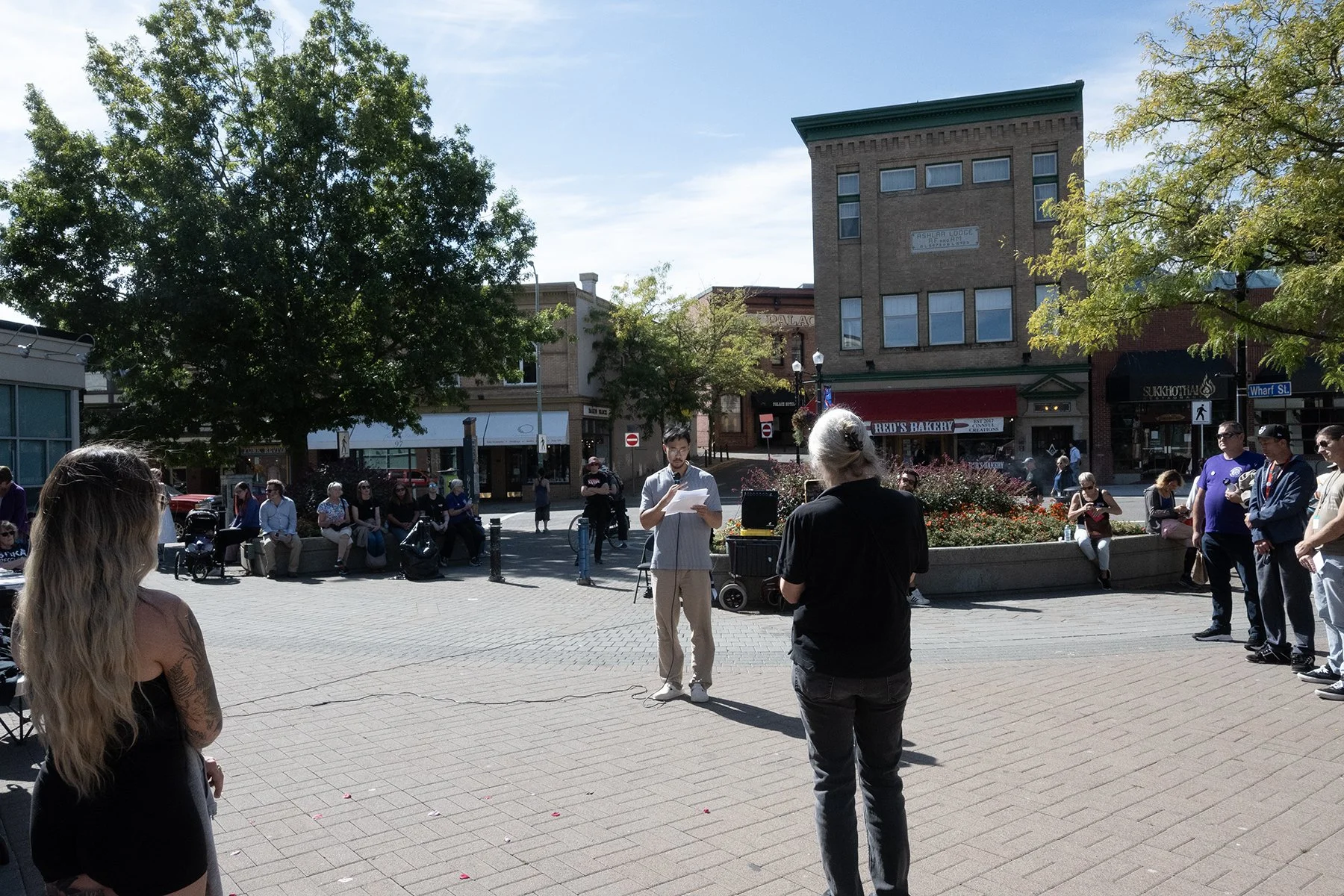
Dr. Nguyen said prevention can look very complex but is about a sturdy and resilient community. (Joe Pugh / CHLY 101.7FM)
August 31st, 2026 marked 25 years of International Overdose Awareness Day, and community members in Nanaimo came together to grieve those who have been lost, and reflect on years of advocacy amidst a crisis.
This year also marks 10 years since the Government of B.C. declared a public health emergency in response to the increase in toxic drug deaths happening across the province. According to the British Columbia Corners Service, as of August 2026, 668 people have died due to the toxic drug crisis in Nanaimo since 2016.
At an event Monday, community groups including Moms Stop the Harm, Risebridge, Aids Vancouver Island, along with Island Health, staffed tables in Diana Krall Plaza to share information about resources for care for those with addiction.
Speeches were given throughout the event.
Dr. Tribesty Nguyen, Medical Health Officer with Island Health for Central Island - Nanaimo, Oceanside, reminded the crowd that behind the statistics, each overdose death is a person.
“My day is often involved with data, numbers, and statistics,” Nguyen said. “I wanted to remind myself, and hopefully everybody here today, that behind every statistic, behind every data point that you see about overdose deaths is someone's kid, someone's roommate, someone's best friend.”
He said in public health there is a well-known framework made up of four pillars. These pillars are things a community can use to address substance use related issues at a community level.
“The first of those pillars is harm reduction; the second is treatment; the third is regulation, and the fourth is prevention. Some of you may have heard of this framework before,” he said. “Some of you may have heard that the third pillar is enforcement, but I intentionally use the word regulation because it implies we need a regulated supply, not an enforcement of the people who use substances themselves.”
He spoke about a friend he lost to the toxic drug crisis.
“He was an artist, deeply creative. He embodied warmth and colour, and I remember he loved to dance not because he was formally trained in dancing, but he just liked to express the music that he was hearing,” he said. “That was someone that the community that I'm in had lost about two years ago, and that's left a hole in my community that has been there ever since.”
He said looking at the four pillars, the fourth one, prevention, is something that doesn’t get talked about enough.
“This is the pillar that doesn't save lives today; it saves lives tomorrow,” he said.
He said prevention can look very complex but is about a sturdy and resilient community.
“It looks like stable housing, alleviating childhood poverty, supporting kids who have been through trauma long before it becomes trauma that they're struggling with as adults,” he said. “It means teaching social, emotional, and resiliency skills for our kids. It means mental health care that's actually there when a teenager needs it, not six months later. It's about simple human connection.”
He said it is important that the community and all levels of government invest in supporting youth to ensure no one falls through the cracks.
“Prevention work is slower. It's hard. It's complex. It's multidisciplinary. It's not black and white. It's not like you can give someone naloxone,” he said. “It doesn't make headlines. It doesn't sound sexy for a front-page newspaper article, but it's how we can shrink this crisis from the source.”
Also speaking Monday was Dr. Jess Wilder, a family and addictions medicine doctor and co-founder of Doctors for Safer Drug Policy.
“This is a hard day for us all. Today we come together to remember the people that we've lost,” Wilder said. “We come together to demand a future where these deaths are no longer accepted as inevitable.”
She said as a doctor she is also used to hearing the overdose crisis talked about through stats and data, but she recognizes every death was a member of the community.
“As I look out in this group today, I see many of you who are here doing this work in this community every day. We know what keeps people safe,” she said. “We know that people are safer when they have access to a predictable, regulated drug supply. We know that low-barrier healthcare and overdose prevention sites save lives. We know that connection, dignity, and belonging are fundamental to health.”
She said the government needs to address the foundations of health and not just the consequences of their absence.
“I have the privilege of caring for people at some of the most difficult moments of their life, but a prescription can't fix a housing crisis. A naloxone kit cannot fix poverty,” she said. “An emergency department is not a substitute for a functioning mental health and addiction system. Policing cannot, and it will not, create the safety, stability, and belonging that we all need to get out of this alive.”
At the event, many of the tables offered naloxone kits, and information about programs and services for those seeking support.
Jess Pearson is a substance use counsellor for Island Health, she and her team were at the event to spread awareness about the services they offer.
“We are a group of counsellors that do substance use counselling specifically, and we're just hoping to get the word out that there is free substance use counselling available to folks in the community via referral,” Pearson said. “It's all free and accessible to anyone over the age of 19.”
She said anyone in the community can access their free programs through a referral at Island Health’s Central Island Access Services location at Brooks Landing.
“Anyone that's looking at exploring their relationship with substance use, how to make change around it, or just kind of getting a sense of what it does for them, what it doesn't do for them,” she said. “It's just this kind of ability to meet people where they're at in their experience and support them in their journey, what that looks like for them.”
As addiction care is not one size fits all, Pearson said they work with the clients to find the best ways to support their needs.
“We believe in harm reduction approaches,” she said. “We do abstinence-based support service as well, so we really like to lead with client-centered care and support the folks that are accessing our service.”
Pearson said their program is for people at any stage of substance use or recovery.
“We have folks coming in that maybe aren't necessarily aware of some of the things that are impacting them around their substance use, and some folks come in and know exactly what they want to work on, but we don't necessarily hold anyone back,” Pearson said.
As well they offer counselling for family members and friends who have been impacted by a person’s substance use.
The event falls a week after the sudden passing of Sara Edmondson, president of the Nanaimo Area Network of Drug Users, also known as NANDU.
Sara was remembered by NANDU and many community members as a strong community advocate and someone who stood up for those in need.
Chris Klein, interim president of NANDU said International Overdose Awareness Day should be renamed to International Overdose Action Day
“I think that we should change the name this year from awareness to action because I think everybody's aware of what the fuck's going on, right?” Klein said, “So I think we should change it to action and get some action done finally for this crisis.”
According to the Government of British Columbia, since 2016, over 19,000 people throughout the province have died due to unregulated toxic drugs.
Funding Note: This story was produced with funding support from the Local Journalism Initiative, administered by the Community Radio Fund of Canada.
Newsroom Ethics • About our Newsroom • Report an Error • Corrections & Clarifications